Children's Nonfiction
So You Want To Be A Candy Scientist
by Linda Soules
Listen to this review
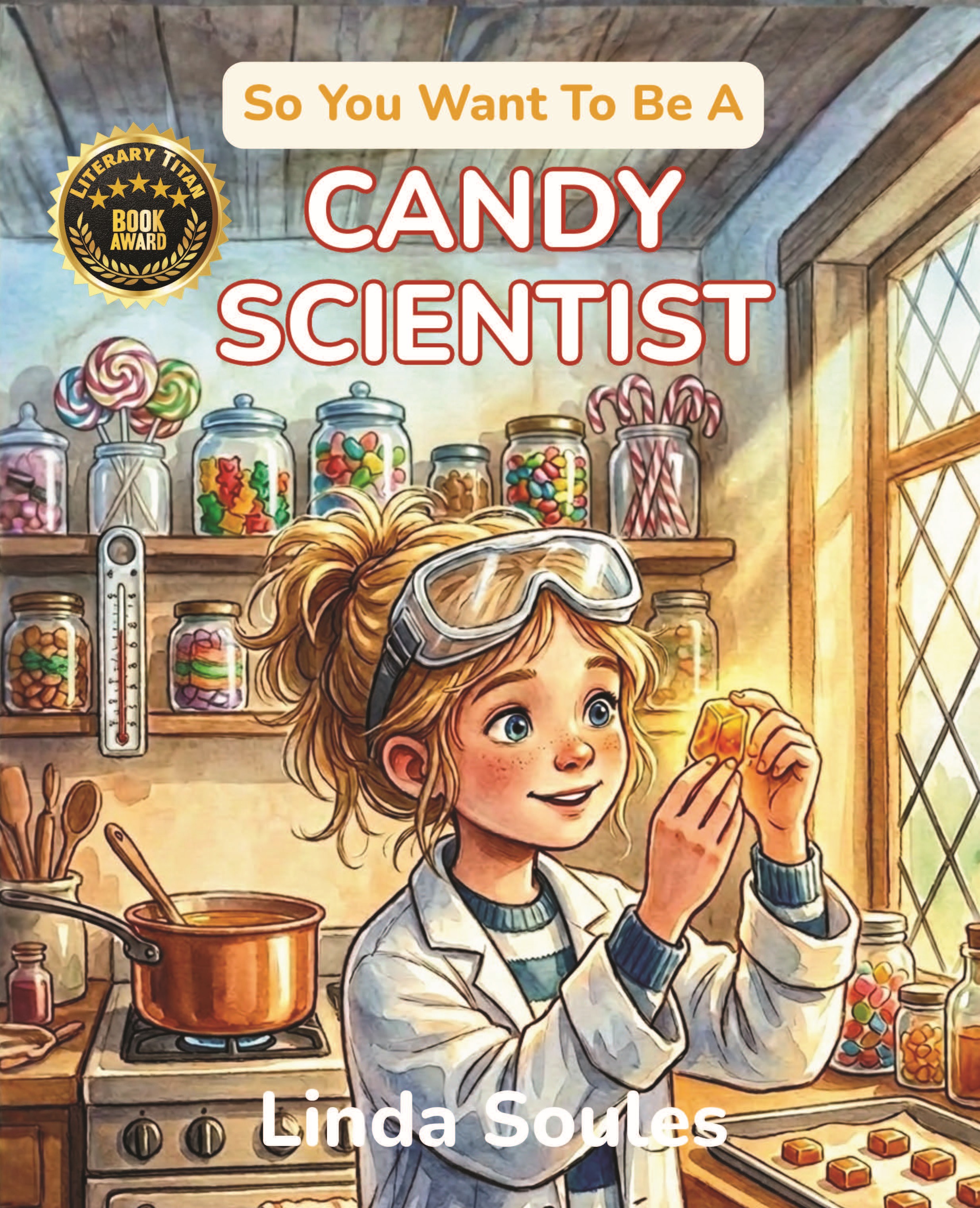
So You Want To Be a Candy Scientist makes an appealing case for taking sweets seriously. Its central idea is that candy is not simply a matter of combining ingredients: temperature, timing, stirring, and cooling can make sugar smooth, cloudy, brittle, or chewy. The book turns that premise into a child-friendly introduction to food science and a practical portrait of a career, with enough vivid detail to make the laboratory feel like a place where curiosity could lead to a real job.
The writing’s strongest asset is its ability to translate technical processes into memorable images. A candy scientist learns to “read sugar the way a musician reads music,” while the thermometer becomes a map of possible textures. These comparisons are more than decorative: they help explain why precision matters. The example of saffron caramel is especially effective. A first batch loses its aroma because the saffron is heated too early; adding it after the pan comes off the heat allows the flavor to bloom. The story gives a concrete shape to experimentation—observe, adjust, try again—without making the science feel remote.
The book is also strongest when it connects concepts to recognizable candy. Its discussion of crystal and glass states distinguishes smooth fudge from large-crystal rock candy and clear lollipops. The sections on Pop Rocks, chocolate tempering, gummy texture, and cotton candy broaden the subject beyond sugar cooking. The “Day in the Life” chapter is a useful change of pace: the hot-weather gummy problem moves from recipe trials to texture analysis, blind tasting, and stability testing. It shows that the work involves patient measurement and teamwork, not just inventing flavors. The account of sensory panels, safety experts, process engineers, and buyers further corrects the idea that a scientist works alone.
As a career guide, the book offers more than encouragement. It names tools such as refractometers, texture analyzers, and water-activity meters, explains what they measure, and suggests activities readers can try at home. Growing sugar crystals and comparing chocolate snaps are especially well matched to the book’s themes: each turns an abstract idea into something observable. The glossary and “Want To Learn More?” pages extend that invitation with terminology, books, websites, and possible next steps. The author’s note also makes a thoughtful argument that creating everyday pleasure deserves care and rigor, a humane counterpoint to the assumption that science matters only when applied to grand or urgent problems.
That enthusiasm, however, sometimes becomes repetition. The same ideas—that a few degrees can transform candy, that failed batches teach, and that science makes delight dependable—recur across the opening, the job’s “best parts,” the challenges, and the conclusion. The recurring lyrical cadence gives the book warmth, but it can also make sections feel more like variations on a motivational message than distinct stages of a career portrait. Readers looking for a brisk, reference-style guide may find the prose over-insistent; others may appreciate its conversational encouragement.
The technical framing also needs some qualification. The opening says that almost every candy begins with sugar and presents candy as largely a transformation of that ingredient. Sugar is a useful organizing thread, but the book’s own later examples—gelatin in gummies, cocoa butter in chocolate, and the roles of proteins, fats, and gelling agents—show how much the field exceeds that simple premise. Similarly, the statement that all candy exists in one of two molecular states is presented as a clean rule, then softened by the description of caramel as a mixture. For a young audience, simplification is reasonable; here, the confident phrasing can make the boundaries sound more absolute than the discussion itself suggests.
Some other claims would benefit from more careful wording or sourcing. The section on sour candy says its acid reacts with the tongue’s sensitive surface and suggests dentists can spot devoted sour-candy fans by enamel wear. Those claims are delivered as punchy facts rather than qualified explanations, and they risk leaving young readers with a more dramatic impression than the book supports. The historical sketches of Harvey Wiley and Milton Hershey are similarly compressed: they introduce food safety and manufacturing problems, but sweeping statements about their effects leave little room for nuance. These are not reasons to dismiss the book’s educational value, but they matter in a work that presents itself as a guide to science.
The practical experiments are engaging, and the sugar-glass activity explicitly says an adult must help. That warning is important: heating sugar to 300°F and pouring it is not a low-risk kitchen activity. The other suggestions are more observational, but the book would be stronger if its safety guidance were consistently prominent wherever readers are encouraged to investigate candy themselves.
Overall, this is an energetic and often illuminating introduction to confectionery science, most successful when it joins an accessible explanation to a specific example or experiment. Its repetitions and occasional overconfident simplifications limit it as a precise science reference, but its curiosity, practical career details, and respect for young readers make it a worthwhile starting point. It is best suited to curious readers around the series’ stated ages of 10 to 14—especially children who enjoy food, hands-on experiments, or imagining how a product is made—and to adults who can help put the more technical and safety-sensitive activities in context.
Share-ready review images
Download square and vertical images for posts, stories, newsletters, and media kits.

For authors
Want a review page like this for your book?
Upload your manuscript, choose a review tier, and get a permanent public editorial review page you can share with readers.
Review My Book← Back to Reviews
