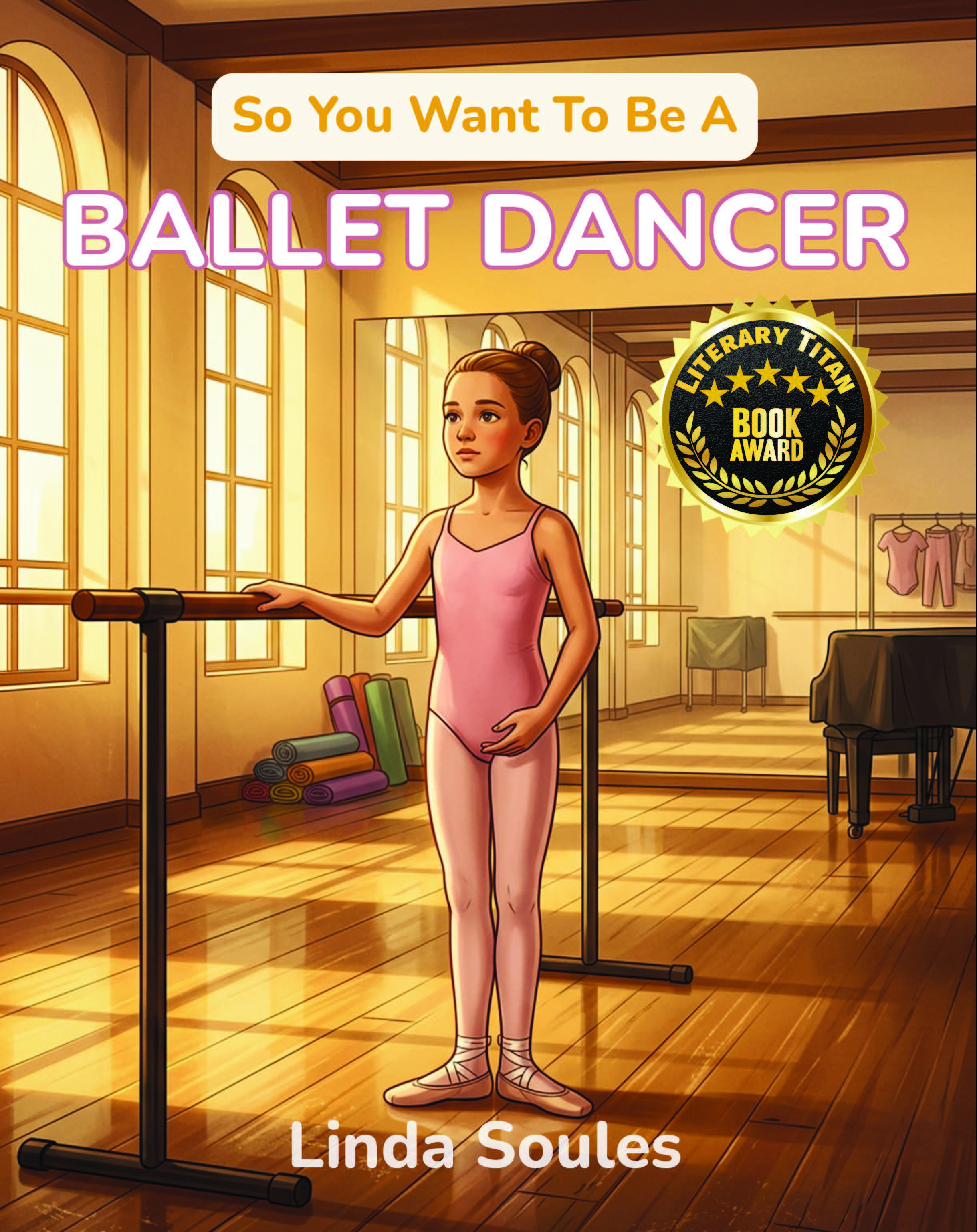
Children's Nonfiction
So You Want To Be A Ballet Dancer
by Linda Soules
Listen to this review
So You Want to Be a Ballet Dancer makes a persuasive case that ballet’s apparent lightness is built on years of demanding work. Linda Soules writes for curious young readers, but she does not reduce the profession to a sequence of glamorous images. The book pairs the spectacle of a grand jeté or a dancer en pointe with the repetition, pain, discipline, and career uncertainty behind it. Its central insight—that technique matters most when it enables a dancer to communicate feeling—is both a useful introduction to the art and a strong organizing principle.
The prose is most effective when it makes physical labor visible. The opening contrasts the audience’s impression of ease with the dancer’s intensive training, while the discussion of pointe shoes describes how each pair is shaped to an individual foot and quickly worn out. The “Day in the Life” section gives that effort a practical rhythm: class, rehearsal, protected rest, a second warm-up, performance, and ice on the feet at home. Such details help readers imagine a working day rather than simply admire a stage image. Soules’s lyrical touches—especially the description of the brief pause at the top of a jump—also convey why dancers might accept such demanding work.
The book’s structure serves its intended purpose well. Short, clearly named sections move from ballet vocabulary and workplaces to tools, working conditions, personal qualities, and ways to prepare. Definitions of terms such as plié, tendu, and arabesque appear in the main discussion and return in a glossary, reinforcing the idea of ballet as a shared physical language. The chapter on colleagues broadens the picture beyond performers, naming artistic directors, ballet masters, répétiteurs, designers, and physical therapists. The practical suggestions—watching a performance, observing a class, or trying to tell a story without words—invite readers to test their curiosity rather than merely consume facts.
Its account of ballet’s history and changing culture adds welcome complexity. The book notes that women did not appear on ballet stages until 1681 and that pointe work developed much later, challenging the sense that the familiar form is timeless. Profiles of Anna Pavlova, Misty Copeland, Rudolf Nureyev, and Maria Tallchief make the history personal, with particular attention to barriers of class, race, and expectation. Tallchief’s refusal to change her name and Copeland’s rise after beginning lessons at thirteen connect individual achievement to questions of belonging. The discussion of adaptive dance likewise resists treating ballet as an art reserved for a single kind of body, while acknowledging that exclusion has been part of its history.
That balance is one of the book’s strengths, though it is not always fully sustained. It recognizes body-image pressures and the narrowness of ballet’s traditions, then says that many schools and companies now welcome dancers of every body type and background. The reassurance is understandable for a young audience, but the book gives little detail about how uneven that change may be or what obstacles remain. Similarly, several striking numerical claims—from daily training hours to landing forces, pointe-shoe use, and cumulative lifting—are presented with confidence but without sources in the supplied text. They make the physical stakes vivid, yet a bibliography or brief note indicating where such figures come from would strengthen the book’s reliability for readers using it as a research resource.
The guidance for aspiring dancers also merits care. The book wisely warns readers not to push a stretch to pain and explains that pointe work should wait until a dancer has developed sufficient strength. However, suggesting that beginners practice turned-out foot positions and single-leg relevé at home may be too compressed for a topic where safe alignment and individual instruction matter. A clearer reminder to seek a qualified teacher before attempting unfamiliar technique would make the advice more responsible, especially for children taking the book as a practical guide.
Soules’s style is warm and frequently memorable, but its emotional register can become repetitive. The book repeatedly returns to devotion, beauty, effort, and the body’s potential, sometimes restating an idea after it has already landed. The rhetorical questions and direct address create an inviting conversational tone, although some older readers may find the earnest encouragement a little insistent. The final exercise—placing a hand on a barre or chair and trying a plié—makes a satisfying return to the simplest movement, but the book’s lyricism sometimes gives general inspiration more space than concrete information about auditions, training pathways, pay, or the practical transition after retirement.
Overall, this is a thoughtful introductory portrait rather than a comprehensive career manual. Its strongest contributions are its vivid account of daily practice, accessible ballet vocabulary, and insistence that performance is both athletic labor and storytelling. Readers seeking detailed, sourced career data or extensive discussion of the industry’s structural pressures may need additional material. For children roughly in the middle-reader range who are drawn to dance—or for parents and teachers looking for a candid starting point for conversation—So You Want to Be a Ballet Dancer offers an engaging, encouraging introduction, provided its practical advice is supplemented by guidance from a qualified dance teacher.
Share-ready review images
Download square and vertical images for posts, stories, newsletters, and media kits.
For authors
Want a review page like this for your book?
Upload your manuscript, choose a review tier, and get a permanent public editorial review page you can share with readers.
Review My Book← Back to Reviews
