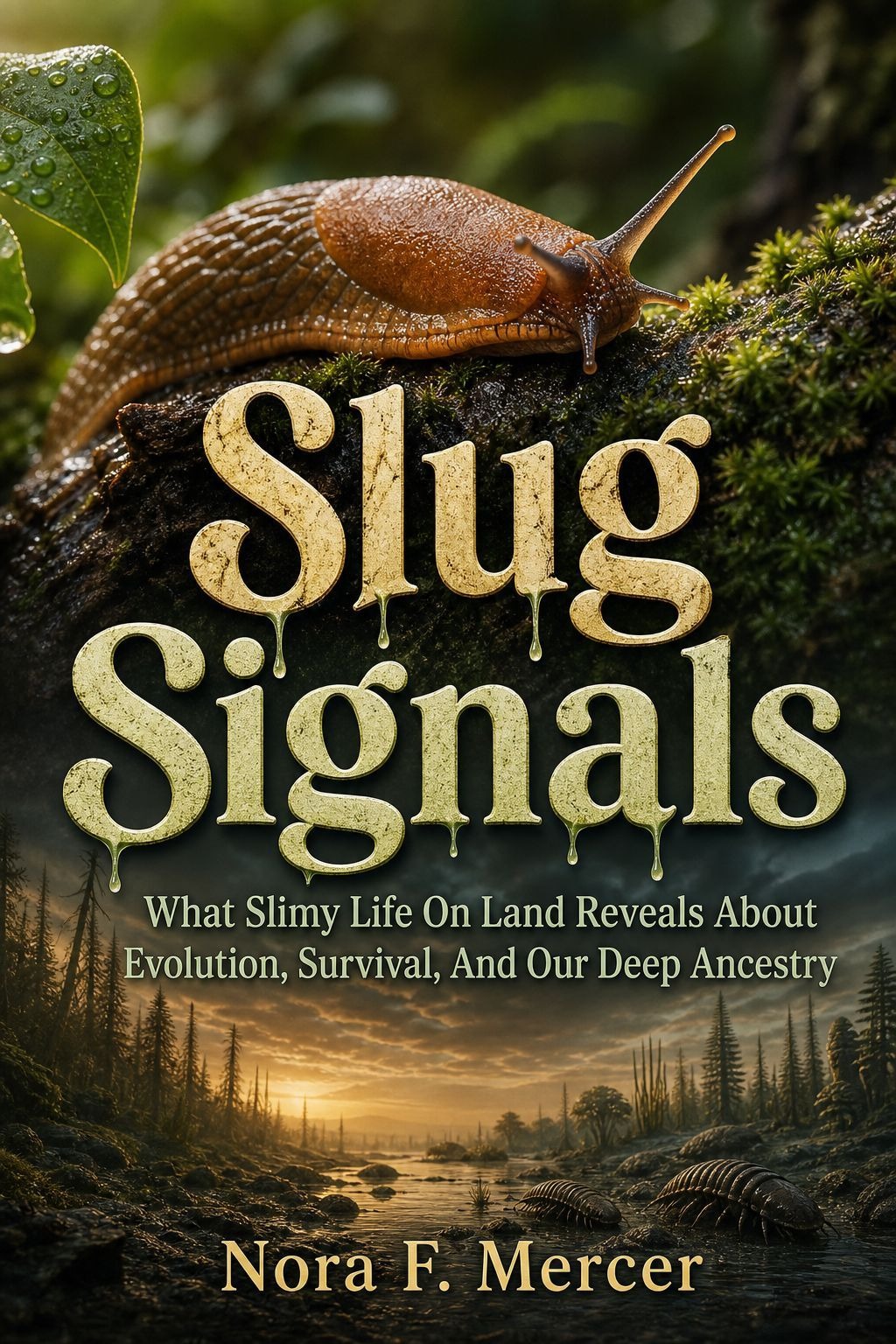
Buy this Book:
Nature / Animals / Mammals (NAT019000)
Slug Signals
by Nora F. Mercer
Listen to this review
Slug Signals is an unusually attentive work of natural history, one that makes a familiar creature feel intellectually expansive without ever romanticizing it. Across ten chapters and a brief appendix, the book builds a cumulative portrait of the slug as an organism shaped by loss, compensation, and exquisite adaptation. Its central argument is stated early and sustained well: a slug is not an “unfinished” snail but a fully realized answer to the ecological problem of living on land without the obvious shelter of a shell. That premise gives the book both its scientific clarity and its philosophical charge.
The prose is the book’s most immediate strength. It is methodical, but never inert; its explanations often move with a calm confidence that suits the subject. In Chapter 1, “The Slug in Plain Sight,” the writer turns the shell into a question of evolutionary architecture rather than mere absence, distinguishing between external shells, hidden remnants, and internalized structures. The result is a deft reframing: the slug’s softness is not treated as deficiency, but as “a different solution.” That kind of phrasing recurs throughout the book, especially when describing mucus, movement, and feeding, where the language repeatedly resists the usual human bias toward hardness, speed, and visible force.
Thematic coherence is another major achievement. Chapter 2, “The Making of Slime,” does more than define mucus; it makes slime the book’s conceptual hinge, linking locomotion, moisture retention, defense, and chemical signaling. The same material can reduce friction, discourage predators, and carry information across the ground. This insistence on multifunctionality is one of the book’s most satisfying intellectual habits. Likewise, Chapter 4’s account of crawling as a muscular wave working in concert with mucus gives the slug’s movement a tangible elegance. The animal is not merely described; it is understood as a negotiated system in which tissue, chemistry, and terrain collaborate.
There is also real originality in the book’s emphasis on the slug as an organism of contact. Repeatedly, the text returns to the idea that the slug lives by reading and rewriting the surfaces around it: soil, leaf litter, bark, stone, and the “thin film” of matter left by decay. Chapter 5, “Eating, Digesting, and Surviving,” is especially effective in this respect. The discussion of the radula as a scraping tool suited to “boundary layers” and softened surfaces is vivid and precise, and it gives the slug’s feeding habits an ecological dignity. Rather than treating slugs as garden pests first and foremost, the book places them within decomposition, nutrient cycling, and the slow conversion of organic matter into soil. That ecological framing is one of the book’s most persuasive contributions.
Structure is another virtue. The chapters move from appearance and mucus to anatomy, locomotion, feeding, behavior, reproduction, evolution, ecology, and environmental vulnerability in a way that feels cumulative rather than repetitive. Chapter 6, on sensing and behavior, and Chapter 7, on reproduction and development, both extend the earlier anatomical arguments without simply restating them. Chapter 8 widens the lens effectively, showing that the slug’s terrestrial life is not a separate story from molluscan ancestry but an extension of it. The book is at its best when it connects the smallest bodily detail to the broadest evolutionary pattern, as in its description of shell loss as “reallocation” rather than subtraction.
Perhaps the book’s most distinctive quality is its tone of patient re-education. It does not merely inform; it attempts to retrain perception. Chapter 9, “Why Slugs Matter in Ecosystems and Human Life,” openly addresses the cultural habit of dismissing slugs as ugly, wet, or destructive. Yet it does so without collapsing into sentimentality. The text acknowledges garden damage and agricultural concern while insisting that these conflicts do not exhaust the animal’s meaning. That balance is important. The book neither excuses the slug’s reputation nor lets that reputation govern the biology. Instead, it asks readers to see how human annoyance coexists with ecological usefulness.
Still, the book is not without limitations. Its biggest strength—its sustained, explanatory calm—can also become a constraint. The prose tends toward continuous abstraction, and while this works well for conceptual framing, it sometimes blunts the immediacy of the living animal. We hear a great deal about what mucus “does,” what the shell “means,” and how evolution “works,” but far less about any sharply individual slug, particular scene, or memorable field encounter. The appendix promises practical observation guidance, and the table of contents suggests a field-guide dimension, yet the chapters themselves remain largely general and analytic. Readers looking for a more tactile natural history, full of firsthand observation or narrative fieldwork, may find the book somewhat remote.
The text’s reliance on repeated explanatory patterns can also create mild redundancy. Several chapters return to the same central claims—that slugs are soft but not weak, vulnerable but not helpless, and dependent on moisture but highly adaptable. These are worthwhile points, and they are consistently supported, but the book occasionally states them in near-parallel formulations across multiple chapters. For a reader already persuaded by the premise, this repetition may feel disciplined; for another reader, it may feel a little over-insistent.
There is also a certain uniformity of register. The style is elegant in its own way, but rarely surprising. It favors measured analogy, careful qualification, and extended explication over vivid compression. That makes the book accessible, especially for non-specialists, but it may leave readers who want sharper factual density, more explicit scientific sourcing beyond the single cited reference, or more varied rhetorical texture wanting more. The notes to “researchers studying molluscs” and the lone citation gesture toward scholarship, but the text itself reads more like a highly polished synthetic essay than a document built for technical debate.
Even so, Slug Signals succeeds on its own terms. It is an intelligent, humane, and often genuinely elegant meditation on an animal most people overlook. Its best chapters show how a soft body can become an ecological strategy, how slime can be both motion and message, and how a shell-less life is not a lesser one but a differently organized one. Recommended for readers who enjoy lucid natural history, evolutionary explanation, and essays that use an unlikely creature to rethink assumptions about adaptation, vulnerability, and ecological value. Readers seeking a brisk field guide, highly detailed primary research, or a more dramatic narrative style may find it a less satisfying fit.
Share-ready review images
Download square and vertical images for posts, stories, newsletters, and media kits.
For authors
Want a review page like this for your book?
Upload your manuscript, choose a review tier, and get a permanent public editorial review page you can share with readers.
Review My Book← Back to Reviews
