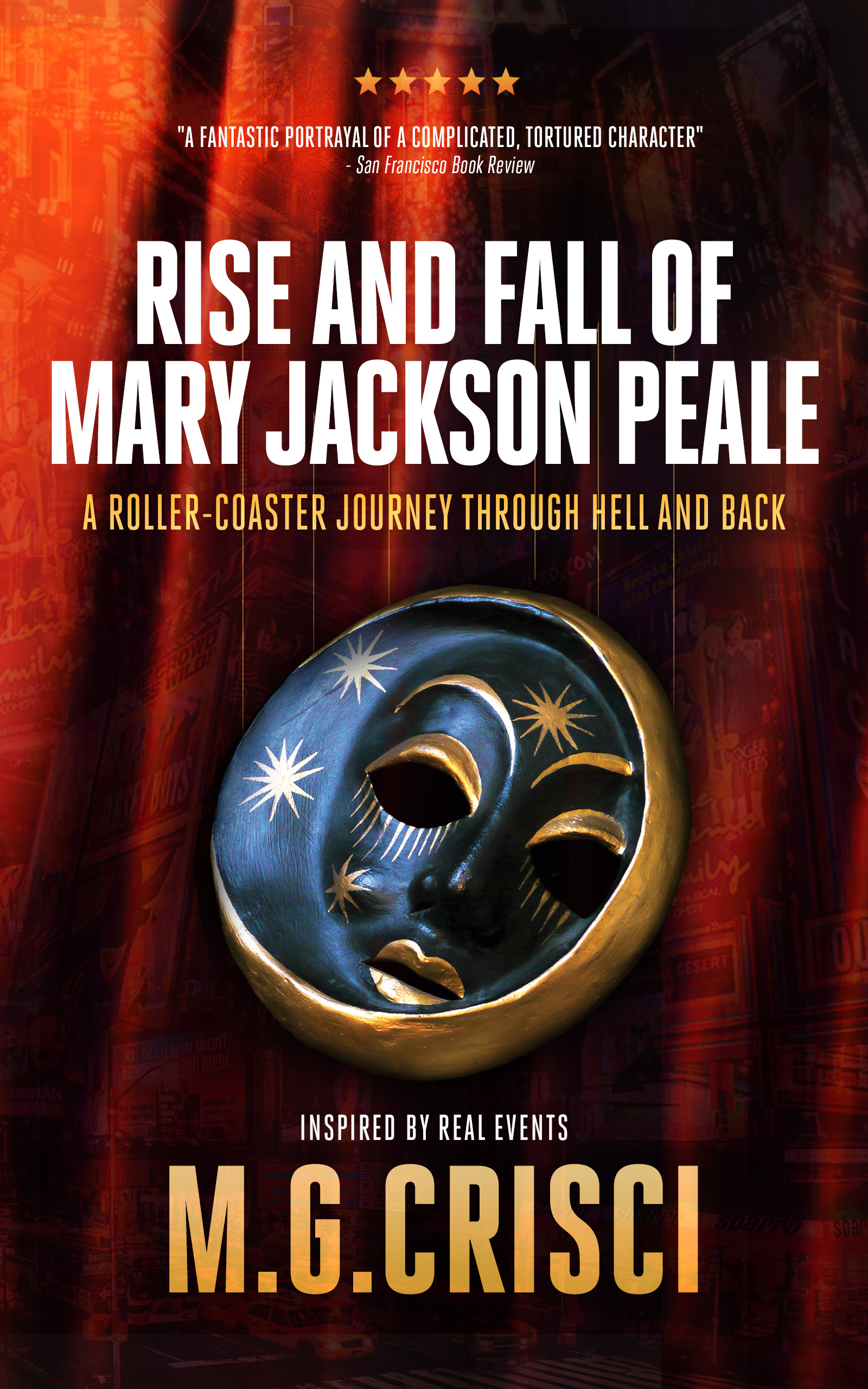
BIOGRAPHY & AUTOBIOGRAPHY / Women (BIO022000)
Rise and Fall of Mary Jackson Peale
by M.G. Crisci
Listen to this review
M.G. Crisci’s Mary Jackson Peale is an exuberantly plotted saga of ambition, appetite, grief, and theatrical showmanship. Its central character begins as Mary Jones, a fisherman’s daughter raised amid her mother’s poetry and her father’s opera, and becomes a formidable theatrical agent in London and New York. Along the way, the novel moves through love affairs, murder, business triumphs, depression, and a late-life romance in Italy. Crisci’s governing idea is that Mary’s capacity for reinvention is both her talent and her danger: she can turn herself into a compelling persona, but cannot so easily remake the past or escape its costs.
The book’s most distinctive strength is its mesh of art and commerce. Mary’s early declaration that she will become the “princess of discovery” sets up a career built on recognizing which plays and performers can reach an audience. Her rise—from improvising a deliberately outrageous image to negotiating productions and correcting David Marks’s suspicious royalty accounts—gives the novel a lively, particular subject. Its theatre-world episodes are at their best when business acumen and performance overlap: Mary reads a room, sells a property, or uses a sharp line to unsettle a gatekeeper. The later success of Lost in Life, aided by the Dapolito family’s neighborhood influence, also complicates the romantic idea that artistic merit alone determines a show’s fate.
Literary and musical references provide a more intimate thread. Mary’s childhood walks to the Brighton cliffs, where Chloe reads Wordsworth, establish poetry as an inheritance rather than a decorative marker of taste. The daffodils return when Elizabeth recites “I Wandered Lonely as a Cloud” beside the lake, joining the lovers’ private history to the landscape. Later, Gianni’s rendition of “Che Gelida Manina” echoes Reilly’s earlier singing and gives the title’s recurring image of a cold hand a tender, connective force. These repetitions lend the sprawling narrative a genuine motif: art can preserve feeling across changes in place and circumstance.
Crisci also writes with conspicuous comic energy. Mary’s dry exchanges with David, her flamboyant approach to Julian Belfrage, and the noisy breakfast scene at Berger’s give the novel a brisk, theatrical rhythm. The dialogue often aims for punchlines, and the narrator moves rapidly from one set piece to the next. That pace makes the book easy to follow through its many locations and turns, while Mary’s practical intelligence and appetite for risk give readers a strong center amid the revolving cast.
But the same velocity becomes a significant structural weakness. Events often arrive as dramatic reversals rather than developments earned over time: Mary’s career accelerates through a succession of lucky openings, influential contacts, and successful deals, while private crises quickly escalate into murder, conviction, institutional treatment, and major romantic changes. The episodic chapters can feel like a chain of scenes competing for attention, with little space for consequences to settle. The novel’s wide scope is ambitious, but its shifts—from erotic comedy to crime story, business narrative, and elegy—do not always cohere. The later revelation of Elizabeth’s death, for instance, recasts earlier romance as tragedy, yet the transition depends on melodramatic disclosures more than on gradual suspense.
Characterization is similarly uneven. Mary’s contradictions—her confidence and insecurity, ambition and longing, self-description as bisexual and continuing attachment to particular women and men—could sustain a searching study of identity. At times, however, the narrative treats sexuality chiefly as provocation or plot fuel, with repeated explicit encounters displacing the emotional reflection that might make them illuminating. Supporting characters can be vivid in a scene but thin beyond it: powerful theatre figures, aristocrats, and Italian relatives are frequently introduced through striking quirks or status, then used to propel the next turn. The result is a protagonist with a memorable drive surrounded by people who sometimes feel more like theatrical entrances than fully developed lives.
The treatment of mental health is also mixed. Mary’s grief and guilt culminate in an overdose and a crisis severe enough to require intensive care, and the novel does show the cost of her attempts to outrun pain. Dr. Myers explicitly rejects the idea that same-sex attraction is a disorder, a useful distinction in a story full of stigmatizing language from other characters. Still, the emotional collapse is rendered in highly sensational terms, and the movement from diagnosis to recovery is less psychologically detailed than the plot’s many professional and romantic turns. Readers seeking a nuanced account of depression or trauma may find the illness chiefly serving the melodrama.
The prose is accessible and often entertaining, but it would have benefited from firmer editing. Awkward constructions, punctuation and spacing problems, and occasional inconsistencies interrupt the flow, particularly in a book whose dialogue depends on timing and whose plot depends on clarity. The author’s conversational narration can be engaging, though it sometimes explains a joke, emotion, or intention after the scene has already made it plain.
Mary Jackson Peale is best suited to readers who enjoy fast-moving, larger-than-life fiction about theatre, ambition, romance, and reinvention, and who welcome a mix of comic excess and melodrama. Its recurring poetry and opera references, and its portrait of Mary’s tireless commercial instinct, give it a distinctive core. Readers looking for restrained realism, tightly controlled plotting, or sustained psychological depth may find its abrupt turns and sensational register less rewarding.
Share-ready review images
Download square and vertical images for posts, stories, newsletters, and media kits.
For authors
Want a review page like this for your book?
Upload your manuscript, choose a review tier, and get a permanent public editorial review page you can share with readers.
Review My Book← Back to Reviews
