SELF-HELP / Communication & Social Skills (SEL040000)
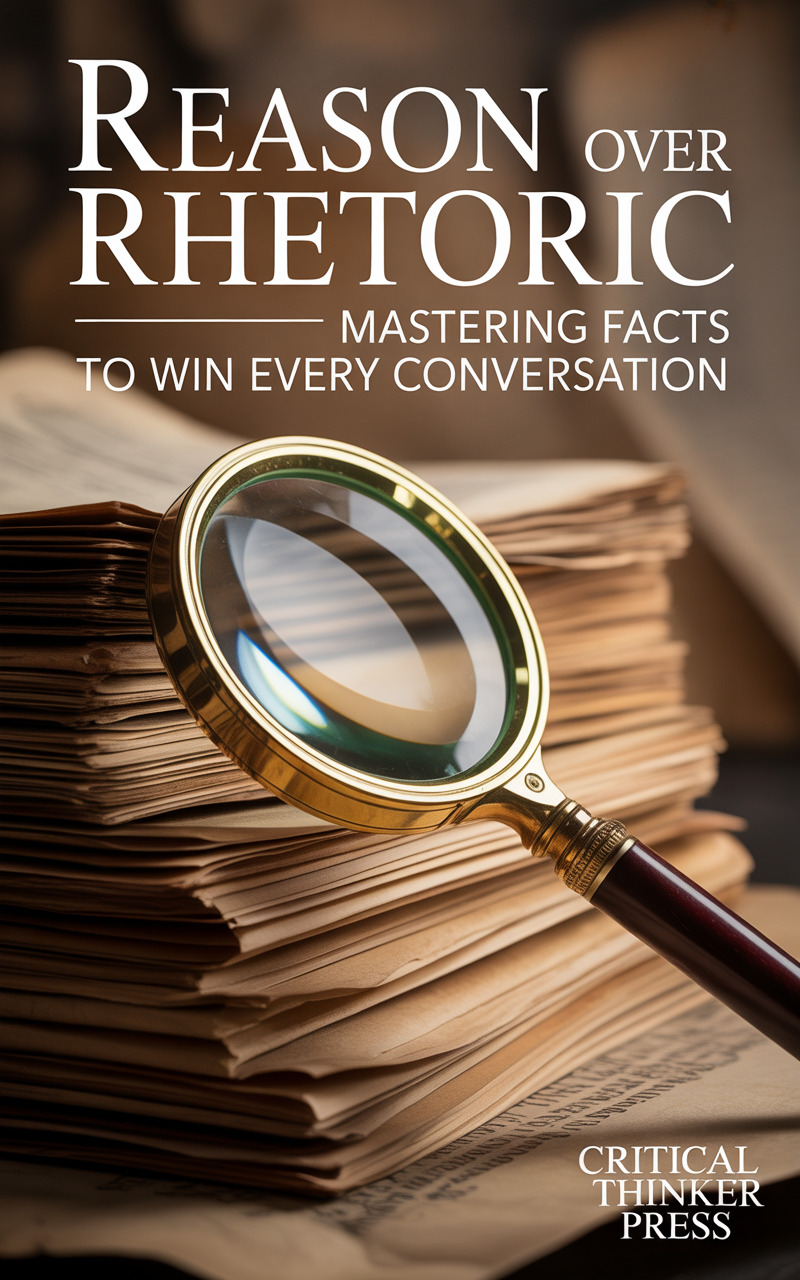
Reason Over Rhetoric
by Critical Thinker Press
Listen to this review
Reason Over Rhetoric is a thoughtful, ambitious, and highly practical guide to one of the most necessary skills in modern life: learning how to think clearly in a world crowded with persuasion, noise, and bias. Across its twelve chapters, the book builds a coherent case for reasoned discourse while remaining refreshingly accessible. Rather than treating critical thinking as an abstract academic exercise, it presents it as a living discipline that shapes debates, relationships, moral judgments, and even everyday choices in the grocery aisle or on social media. That practical emphasis gives the book both relevance and momentum.
What stands out first is the book’s steady, instructive voice. It explains concepts such as cognitive bias, pathos, logical fallacies, and ideological bias with an admirable clarity, but it never talks down to the reader. In Chapter 2, for example, the discussion of confirmation bias, anchoring, overconfidence, and hindsight bias is especially strong because it shows not just what these errors are, but why they feel so natural. The book understands that people do not abandon bad reasoning simply because they are told it is bad; they need to see how the mind itself nudges us toward error. That scientific grounding gives the book authority and helps it avoid sounding merely moralistic.
One of the book’s greatest strengths is its structure. The chapters progress logically from the foundations of reason and rhetoric in Chapter 1, to the science of thought in Chapter 2, to evidence, emotional appeals, fallacies, belief revision, ideology, morality, and finally everyday application and mindset. This cumulative architecture is effective because each chapter feels like a new layer added to a larger intellectual toolkit. Chapter 5, on logical fallacies, is particularly useful in this regard: by covering appeal to authority, straw man, false dichotomy, ad hominem, equivocation, slippery slope, hasty generalization, and begging the question, the book gives readers a broad and practical vocabulary for diagnosing weak arguments without losing sight of civility.
The book also succeeds in its treatment of rhetoric as something to be understood rather than simply condemned. Chapter 1 is especially insightful here. It avoids the simplistic notion that rhetoric is inherently manipulative, instead showing how devices such as repetition, rhetorical questions, analogies, hyperbole, bandwagon appeals, loaded language, storytelling, and appeals to tradition can either illuminate or obscure. That nuance is one of the book’s smartest choices. It encourages readers to become more discerning communicators, not cynical skeptics. Likewise, Chapter 4’s focus on emotional appeals is balanced and humane: pathos is acknowledged as part of human communication, but the reader is repeatedly reminded that emotional force is not the same as evidential support.
Another notable achievement is the book’s emphasis on ethical reasoning. Chapter 8, which explores morality through reason, and the later discussion of balancing moral perspectives with evidence, elevate the book beyond a mere handbook of argumentation. Here, the author is not simply concerned with how to win debates but with how to have honest, fair, and principled conversations about difficult questions. That moral seriousness gives the book depth. The insistence on honesty, respect, and intellectual humility feels especially timely in an era when discourse is often rewarded for volume rather than integrity.
The book is at its most effective when it connects abstract ideas to everyday life. Chapter 9’s emphasis on sourcing and presenting verified facts, along with Chapter 11’s focus on applying critical thinking outside debate, makes the material feel immediately usable. The examples involving product claims, media consumption, and personal finance are simple but effective, showing how reason can become a daily habit rather than a rare intellectual performance. Chapter 10 is similarly strong in its guidance on respectful discourse: active listening, reflective paraphrase, measured tone, and clear boundaries are presented not as soft skills in the shallow sense, but as essential practices for truth-seeking dialogue.
Stylistically, the book is lucid and energetic. Its repeated reminders to pause, question, verify, and reflect create a motivating rhythm that suits the subject well. The prose is often encouraging without becoming simplistic, and the recurring contrast between reason and manipulation gives the chapters a unifying thematic spine. Readers who enjoy self-improvement books with intellectual substance will find much to admire here, especially because the book treats rationality as a discipline of character, not merely a technique.
If there is any limitation, it is that the book sometimes covers such a wide conceptual range that a few readers may wish for even more extended case studies or fuller real-world illustrations, especially in the later chapters on ideology and morality. At moments, the breadth of examples can make the book feel more like a comprehensive primer than a deeply specialized investigation. But this is a very small tradeoff for its accessibility and scope. For its intended purpose, the coverage is admirably direct and effective.
Ultimately, Reason Over Rhetoric is an intelligent, useful, and genuinely constructive book. It offers readers not just a defense of logic, but a pathway toward clearer thinking, fairer discussion, and more grounded judgment. Its blend of scientific insight, ethical seriousness, and practical guidance makes it both timely and enduring. For anyone who wants to think more carefully, argue more fairly, and live with greater intellectual clarity, this is a book I strongly recommend.
Share-ready review images
Download square and vertical images for posts, stories, newsletters, and media kits.
For authors
Want a review page like this for your book?
Upload your manuscript, choose a review tier, and get a permanent public editorial review page you can share with readers.
Review My Book← Back to Reviews
