Psychology
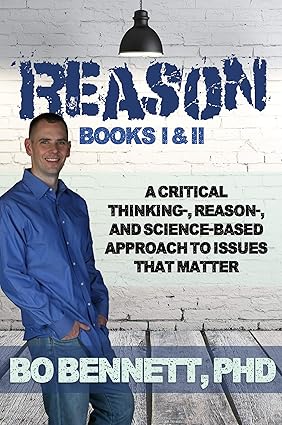
Reason: Books I & II: A Critical Thinking-, Reason-, and Science-based Approach to Issues That Matter (Dr. Bo's Critical Thinking Series)
Reason: Books I & II by Bo Bennett, PhD is a rare and welcome synthesis of social psychology, scientific literacy, and plainspoken moral urgency. From the opening Preface—where a wry anecdote about the Flat Earth Society becomes a springboard for the book’s central thesis—to the practical closing chapters in Part VI on polarization and civic responsibility, Bennett writes like a teacher who also loves a good conversation: clear, rigorous, and frequently amused. The result is a collection of essays that both instructs and entertains without sacrificing seriousness of purpose.
Bennett’s strengths are evident on every page. His writing style is brisk and accessible; technical ideas such as Bayes’ Theorem and the Dunning–Kruger effect are explained with metaphors and examples that make them memorable rather than intimidating. The book’s architecture—six parts that move from “Science Works” through “Rationally and Scientifically Correct,” health and behavior, skepticism, and finally civic action—gives readers a logical progression from concept to application. Chapters like “A Guide for Trusting Sources of Science, for the Non-Scientist” and “Methodology Over Conclusion” are exemplary: practical, evidence-minded, and full of concrete checklists that a reader can apply the next time a headline or Facebook post tempts credulity.
Originality is a quiet virtue here. Rather than recycle slogans, Bennett brings his social-psychology training to bear on contemporary debates: Part II’s essays—“#BlackLivesMatter and Racism Today in America,” “Is ‘Sex Addiction’ a Myth?,” and the provocative “Dismissing Whitey: The Voice of the Non-Marginalized in a World Full of Marginalized Groups”—navigate sensitive topics with a combination of data-awareness and moral clarity. Similarly, his treatment of health and willpower in Part III (“Willpower, Smillpower. A Better Alternative” and “Seven Reasons Why We Find Fad Diets Irresistible”) is both empathetic and corrective, avoiding moralizing while offering usable strategies.
Part V, “A Healthy Dose of Skepticism,” is a particular highlight: essays such as “Dead Men Don’t Tell Tales: Understanding the Survivorship Bias,” “The Psychology Behind the Anti-Vaccine Movement,” and the lucid unpacking of conspiracy thinking equip readers to engage the most persistent public errors in reasoning. Bennett’s frequent insistence that we value methodology over comfortable conclusions is an ethical and intellectual through-line that elevates the book from primer to toolkit.
If there is a minor caveat, it is that readers seeking deep technical derivations—full mathematical proofs or exhaustive statistical appendices—will find the book’s emphasis appropriately pitched toward the lay reader rather than specialists. That choice is a strength for public education, though specialists may wish for footnotes or references in greater depth (Bennett does provide thoughtful footnotes and further reading suggestions, however).
Overall, Reason is an engaging, well-structured, and urgently useful contribution to public discourse. It models the habits of thought it advocates: curious, skeptical, generous, and methodical. I enthusiastically recommend this book to anyone who wants to think more clearly about science, society, and the responsibilities of citizenship. Read it, share it, and keep it on your reference shelf.
Share-ready review images
Download square and vertical images for posts, stories, newsletters, and media kits.
For authors
Want a review page like this for your book?
Upload your manuscript, choose a review tier, and get a permanent public editorial review page you can share with readers.
Review My Book← Back to Reviews
