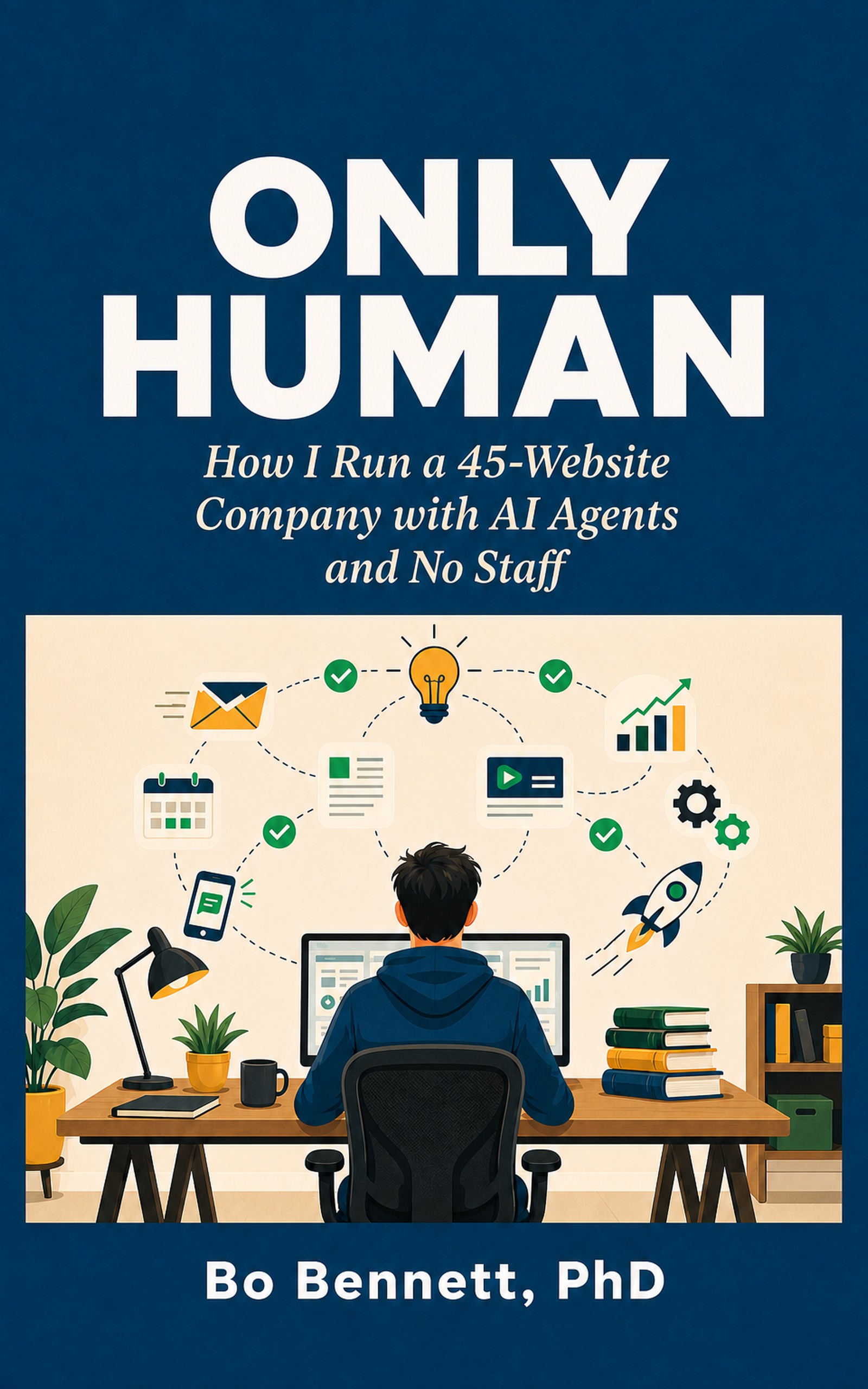
Buy this Book:
Only Human
by Bo Bennett, PhD
Listen to this review
Only Human makes a deliberately grounded case for AI agents by starting with a claim that sounds like a provocation: the author is the only person working at a company that runs 45 websites. The book’s most persuasive achievement is to make that claim concrete. Rather than predicting an automated future in the abstract, it shows how agents handle customer email, engineering tickets, publishing projects, bookkeeping preparation and marketing—and where the human owner still intervenes.
The author’s prose is plain, brisk and largely free of technological grandstanding. The opening image of a working day beginning with emails that each end in a decision, often answered “Do it,” “No,” or “Send,” establishes the book’s central idea with useful economy: the owner’s job has shifted from performing tasks to making choices. That focus carries through the chapters. In Chapter 6, for example, an author’s revised ebook is tracked from receipt of a manuscript through distribution and confirmation that a store has processed the new edition. The project is not presented as a spectacular feat; its value lies in the details that prevent it from quietly stalling.
The strongest sections are often the most specific. Chapter 4’s account of a customer who could not complete a picture book shows an agent checking payment, diagnosing the missing step, generating illustrations and confirming the finished file. The account-deletion example is equally telling: because the action is difficult to reverse, the agent asks for confirmation and verifies the reply before proceeding. These cases give substance to the book’s repeated emphasis on boundaries, verification and accountability. Its concise rules—“Approval is not proof” and “Test the way the customer will meet it”—are more useful than a general assurance that AI can be trusted.
Chapter 10 is especially effective because it gives failure the same attention as success. An agent uses 25 of 30 available cloud builds because a cost-control rule was stored where not every agent could see it. A supposedly retired narration service remains in use through an overlooked fallback. Riley’s phone voice passes tests based on recordings but performs poorly on a real call. And a research agent mistakes 3,551 started trailer jobs for 3,551 completed trailers. These episodes make a strong argument that many failures arise not from a machine’s lack of intelligence but from weak procedures, incomplete testing and careless definitions. The author’s willingness to show errors—including errors that could have inflated the book’s own claims—lends the narrative credibility.
The structure is clear and practical. Each chapter isolates a business function, explains what the agents do, identifies the decisions retained by the owner and ends with a small exercise. The appendix gathers the book’s 28 rules into a usable reference. This design will suit readers who want to translate ideas into procedures rather than merely learn about AI. The book also makes a valuable distinction between routine work and bespoke work: automated cover production may handle standard needs, while commissioned illustration, human editing and narration remain matters for specialists. That is a more thoughtful position than treating replacement as the only measure of technological progress.
The author’s voice is at its best when it admits trade-offs. Building tools means taking on maintenance; agents still make mistakes; and saved hours come with the cost of reviewing decisions. The chapters on customer service and project management also show that speed is not the only benefit claimed: authors receive updates and fixes without waiting for the owner to notice a problem. Still, the evidence comes from one company, one owner and a closely integrated set of tools. The cases are informative, but they do not establish that the same results will follow for a business with different risks, systems or customer expectations.
That limitation matters because some of the most important technical details are withheld. Chapter 4 calls containment the company’s “single most important design decision,” but declines to explain how its safeguards are built. The author gives a reason—protecting the company’s systems—but readers seeking a replicable guide will have to take much of the safety architecture on trust. Similarly, Chapter 12 discusses AI, upkeep, mistakes and attention as costs without giving actual operating totals. The book offers sound categories for doing one’s own calculations, but its claims of savings cannot be independently assessed from the figures provided.
There is also a commercial tension the book acknowledges without fully resolving. PrivateChief is presented as the system that gives the owner a “front door” to Higgins, and the final chapter describes its paid membership. The author is candid about this connection, and the book also discusses alternatives, including hiring people or using a general AI assistant. Even so, the account is both a case study and an argument for a product built by the author. The repeated “Try it this week” exercises are generally relevant, but their steady rhythm can make the book feel like a carefully designed business guide and a product introduction at once.
Only Human is therefore most valuable as a candid operational case study, not as a universal blueprint or a technical manual. Small-business owners, solo operators and managers curious about delegating repeatable work will find its examples and decision rules useful, particularly if they are prepared to adapt them rather than copy them wholesale. Readers looking for detailed implementation instructions, audited cost comparisons or broad evidence about AI’s effects on work may find the account too bounded. For its intended audience, however, the book offers a practical and unusually clear lesson: automation depends less on letting an agent do everything than on defining what it may do, how its work is checked and where a human must remain responsible.
Share-ready review images
Download square and vertical images for posts, stories, newsletters, and media kits.
For authors
Want a review page like this for your book?
Upload your manuscript, choose a review tier, and get a permanent public editorial review page you can share with readers.
Review My Book← Back to Reviews
