Poetry
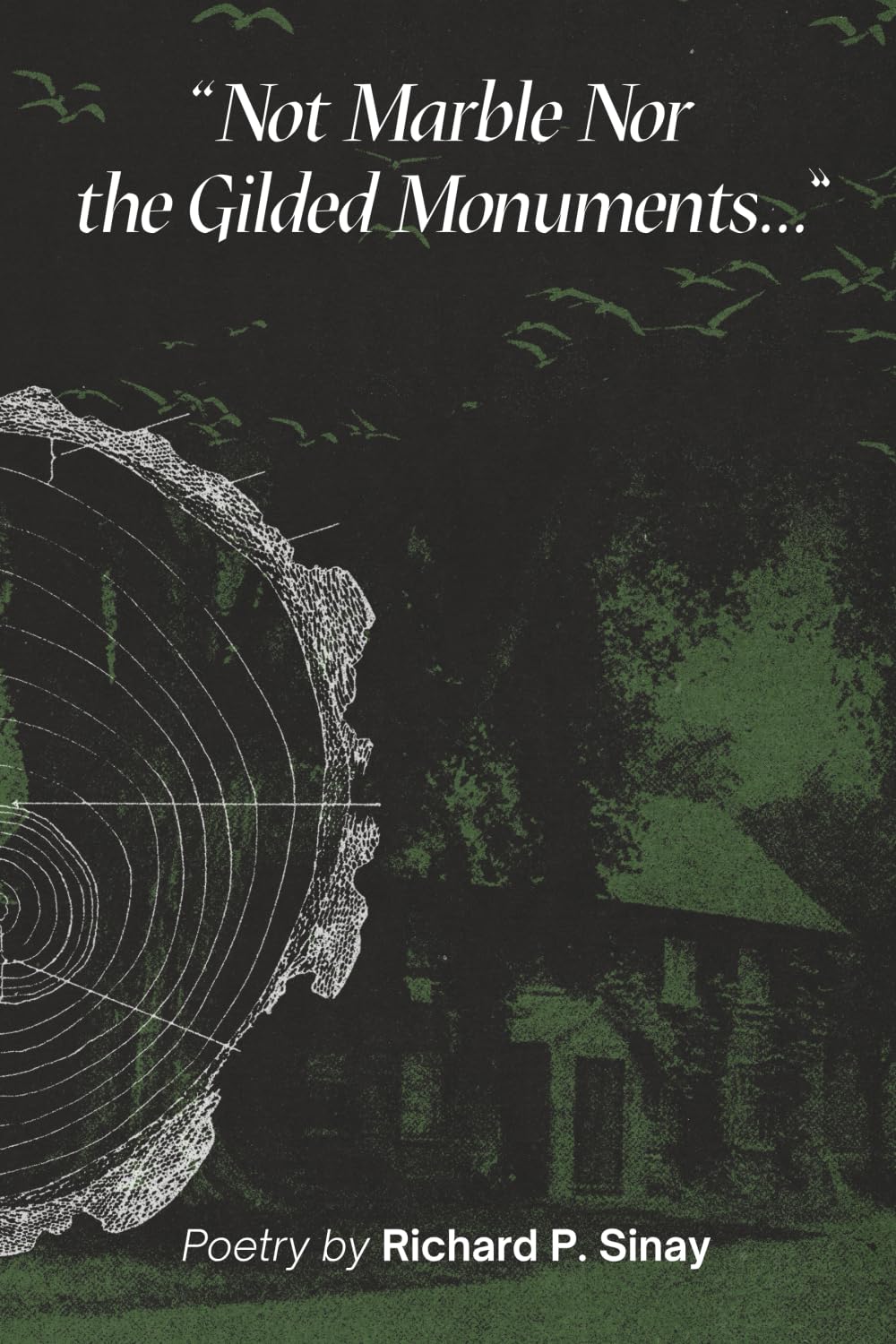
"Not Marble Nor the Gilded Monuments..."
by Richard Sinay
Listen to this review
Richard P. Sinay’s Not Marble Nor the Gilded Monuments… takes its title and governing ambition from Shakespeare’s Sonnet 55: to preserve a life, love, or passing moment in words. Across six sections, the collection moves through time, literary memory, nature, bereavement, romance, and assorted observations. Its introductory essay gives the poems a personal frame, explaining how Shakespeare shaped Sinay’s early writing and how the author, at seventy-seven, has gathered work composed over decades. The result is less a tightly unified new sequence than an archive of a life spent reading, teaching, loving, and trying to make experience last.
That archive has genuine points of interest. The poems often begin with ordinary scenes—a beach walk, a garden, a quiet Disneyland after closing—and use them to approach larger questions about mortality and attachment. “After-Hour Sounds at Disneyland” renders the empty park through specific details, including the Matterhorn, Tomorrowland Pond, and the Castle, giving its solitude a place-bound vividness. “The Backyard” similarly makes familiar plants and garden structures markers of memory and absence. These pieces are strongest when the concrete world carries the feeling, rather than when the poem explains what the feeling means.
Nature poems also show Sinay’s sharper descriptive instincts. In “Bulldozers,” machines arrive at the forest edge with the force of “runaway elephants,” while the speaker anticipates being next in the path of destruction. The poem’s alarm is direct, but its escalating imagery makes the threat palpable. “A Rhodora Grew” sets a flower against roads and development, and “Nature and Man” turns the idea of human adaptation toward an uneasy recognition that people create some of the conditions they struggle to endure. These works offer more than scenic appreciation: they register a conflict between living nature and the systems that consume it.
The collection’s emotional center lies in its elegies. “The Passing of a Soldier” conveys grief through the recurring image of a list and the silence that follows its arrival. “Elegy for Pat Hadley” remembers a colleague as teacher, artist, athlete, and mentor, drawing its mountain-climbing imagery from the account of his life and death. Most expansive is “A Poem of Allusions for Gary,” in which a mundane search at a hardware store gives way to anxiety over the speaker’s gravely ill brother. References to Dylan Thomas, John Donne, Thornton Wilder, and Shakespeare arise from that personal crisis; they can feel crowded, but they also reveal literature functioning as the speaker’s language for confronting mortality.
Sinay is candid in the introduction about his relationship to poetic craft. He describes the five Shakespeare sonnet parodies as playful exercises, acknowledges the limits of his imitation, and says many poems are free verse. That modesty is useful context: the book is most rewarding as a record of a lifelong literary engagement, not as a claim to the formal authority of the writers it admires. “My Professor and Shakespeare,” “A Novel,” and “A Life of Literature” make the pleasure of reading and teaching explicit. The collection’s recurring belief that books and poems preserve experience is coherent, even when its individual expressions are less distinctive.
That distinction matters because the writing is notably uneven. Many love poems rely on familiar declarations—eternal devotion, beauty, longing, and hearts in pain—and sometimes repeat rather than develop an idea. Rhyme and meter can create momentum, but in several poems they also produce strained phrasing or awkward syntax. The text contains conspicuous typographical, grammatical, and proofreading problems, from misspellings to malformed lines; these are especially distracting in a collection so concerned with the precision and endurance of words. The book also repeats pieces or closely related versions, including “Your Angelic Traits,” “A Life of Literature,” and “I Am Conscious of Time,” while “The Mind” and “Thoughts” substantially overlap. Clearer selection and editing would make the volume more persuasive.
The breadth of the contents is both an asset and a limitation. Readers can trace shifts in subject and sensibility across poems dated from the late 1960s to 2021, and the author’s introductory comments help explain the personal circumstances behind several sections. But the sequence can feel accumulative rather than shaped: poems of sharply different quality sit side by side, and recurring themes—especially time, romantic loss, and the survival of love in writing—sometimes blur together. The abundance may suit readers interested in a personal poetic record, but those seeking sustained formal innovation or a carefully curated sequence may find the collection diffuse.
Not Marble Nor the Gilded Monuments… is most valuable as a testament to a reader and teacher’s lifelong conversation with poetry, particularly Shakespeare, and as a candid record of moments the author wished to keep. Its best pieces anchor reflection in physical detail or particular acts of remembrance; its weaker ones lean on familiar sentiment and would benefit from more rigorous revision. Readers drawn to personal, accessible verse, literary allusion, and the preservation of memory are the audience most likely to find meaning here.
Share-ready review images
Download square and vertical images for posts, stories, newsletters, and media kits.
For authors
Want a review page like this for your book?
Upload your manuscript, choose a review tier, and get a permanent public editorial review page you can share with readers.
Review My Book← Back to Reviews
