Buy this Book:
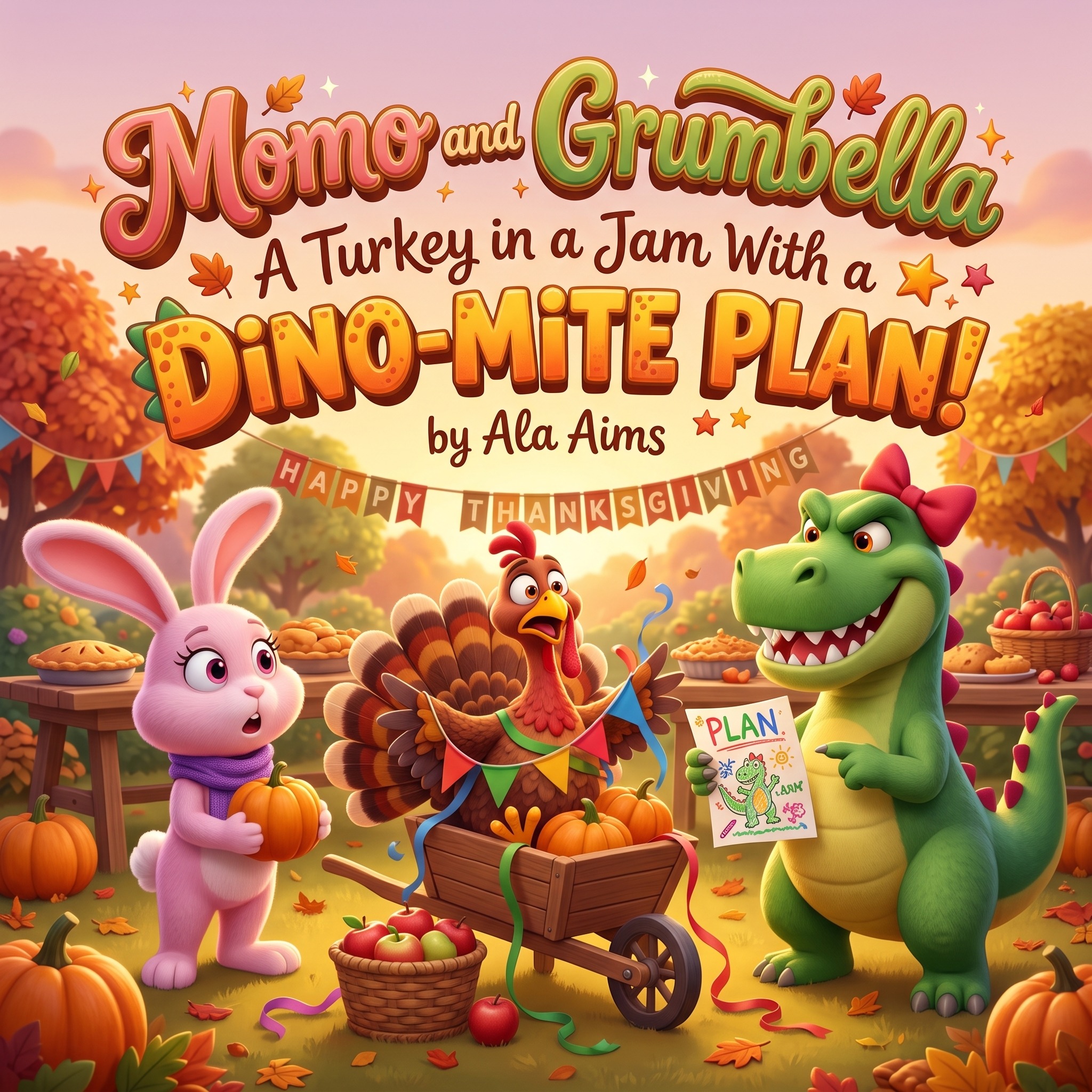
Momo and Grumbella: A Turkey in a Jam With a DINO-MITE Plan!
by Ala Aims
Listen to this review
Momo and Grumbella: A Turkey in a Jam With a DINO-MITE Plan! builds a Thanksgiving story around a simple, child-friendly misunderstanding: a turkey hears that people are serving turkey for dinner and decides the safest solution is to become a dinosaur. The premise gives Ala Aims an immediate comic engine, and the book follows it with briskly escalating mishaps. The turkey’s transformation is entirely make-believe, but his conviction that a new identity can protect him carries the story from the garden to the dinner table.
The opening establishes the book’s preferred register: bright autumn imagery, energetic dialogue, and conspicuous sound effects. Momo’s garden is “painting” itself in reds, oranges, and golds, while Grumbella’s stomach answers with a repeated “GRRRRRRUMBLE!” Capitalized words, elongated roars, and quick exchanges make the text easy to perform aloud. The turkey’s “ROOOAAA—GOBBLE-GOBBLE!” is especially apt: his effort to sound fearsome is undermined by the unmistakable turkey noise. This gap between intention and result is the story’s most dependable source of humor.
The comic episodes also give the central joke useful variation. The turkey tries stomping like Grumbella, falls headfirst into leaves, and fashions a tail from twigs and leaves that sends a pumpkin flying. Later, he attempts to hide in a pumpkin, pose as a scarecrow, and disappear under leaves. These physical gags are clear and visual, and their escalating disorder creates momentum. The dinner preparations provide a final run of mishaps—cranberry sauce, scattered napkins, and a pie stuck on the turkey’s head—before the characters settle around the table.
Underneath the slapstick, the book touches on fear, belonging, and accepting oneself. The turkey’s declaration at the end, “I nearly missed Thanksgiving trying to be something I’m not,” states the lesson plainly. It is a reassuring message for young readers, made concrete by his anxious attempts to disguise himself and his eventual welcome as a guest rather than a meal. Momo responds to his panic with patience, sitting beside him and explaining what Grumbella is actually hungry for. Her calm attention is an appealing counterweight to the turkey’s frantic imagination.
Grumbella’s role is more complicated, and potentially more amusing. She is introduced through her appetite—“SECOND HELPINGS!”—and her growling stomach repeatedly triggers the turkey’s fear. When she learns what he thinks, she laughs and calls him her “long-lost COUSIN,” though she admits she did not believe his dinosaur claim. The scene makes clear that the danger was a misunderstanding, but the cousin joke is less a developed relationship than a playful way to include him. Grumbella’s teasing is meant to be affectionate; very young readers may nevertheless find her initial hunger and sharp teeth briefly alarming before Momo clarifies the situation.
The story’s structure is straightforward and well suited to an early read-aloud: a seasonal setup, a comic plan, successive failures, a moment of fear, reassurance, and a communal Thanksgiving ending. The closing exchange, in which the turkey roars once more and Grumbella asks whether he has learned anything, gives the story a light circularity. He has accepted his place at the table, but he has not abandoned the dinosaur performance. That small refusal to become entirely sensible keeps the ending playful rather than turning it into a solemn lesson.
The same simplicity is also a limitation. The plot depends on the turkey misunderstanding ordinary talk about dinner, and once Momo explains the menu, the conflict resolves quickly. The repeated stomach growls and emphatic reactions may delight children who enjoy broad, predictable comedy, but the accumulation of capitals, exclamation marks, and sound effects can make the prose feel loud on the page. Some jokes are followed by explanations or another reaction, which slightly blunts their timing. Readers looking for subtle humor, a more layered emotional arc, or a distinctive exploration of Thanksgiving traditions may find the book familiar in both its lesson and its comic devices.
The supplied text credits BookBudKids with assisting in the creation of both the story and illustrations. Since the material provided for review contains the text but not the illustrations, their contribution to the book’s visual storytelling cannot be assessed here. The prose itself clearly invites expressive performance and offers scenes that could support lively pictures, but the review can only speak to what is present in the supplied manuscript.
Overall, this is a cheerful, accessible seasonal tale whose strongest assets are its read-aloud energy, physical comedy, and reassuring message about friendship and being accepted. Its humor is broad and its moral explicit, so it is likely to suit younger children and adults seeking a light Thanksgiving story to share, especially readers who enjoy silly voices and repeated sound effects. It will be a weaker fit for readers seeking more complexity or originality, but for a short, playful story about a turkey who wants to be anything except dinner, its warmth and comic momentum are easy to appreciate.
Share-ready review images
Download square and vertical images for posts, stories, newsletters, and media kits.
For authors
Want a review page like this for your book?
Upload your manuscript, choose a review tier, and get a permanent public editorial review page you can share with readers.
Review My Book← Back to Reviews
