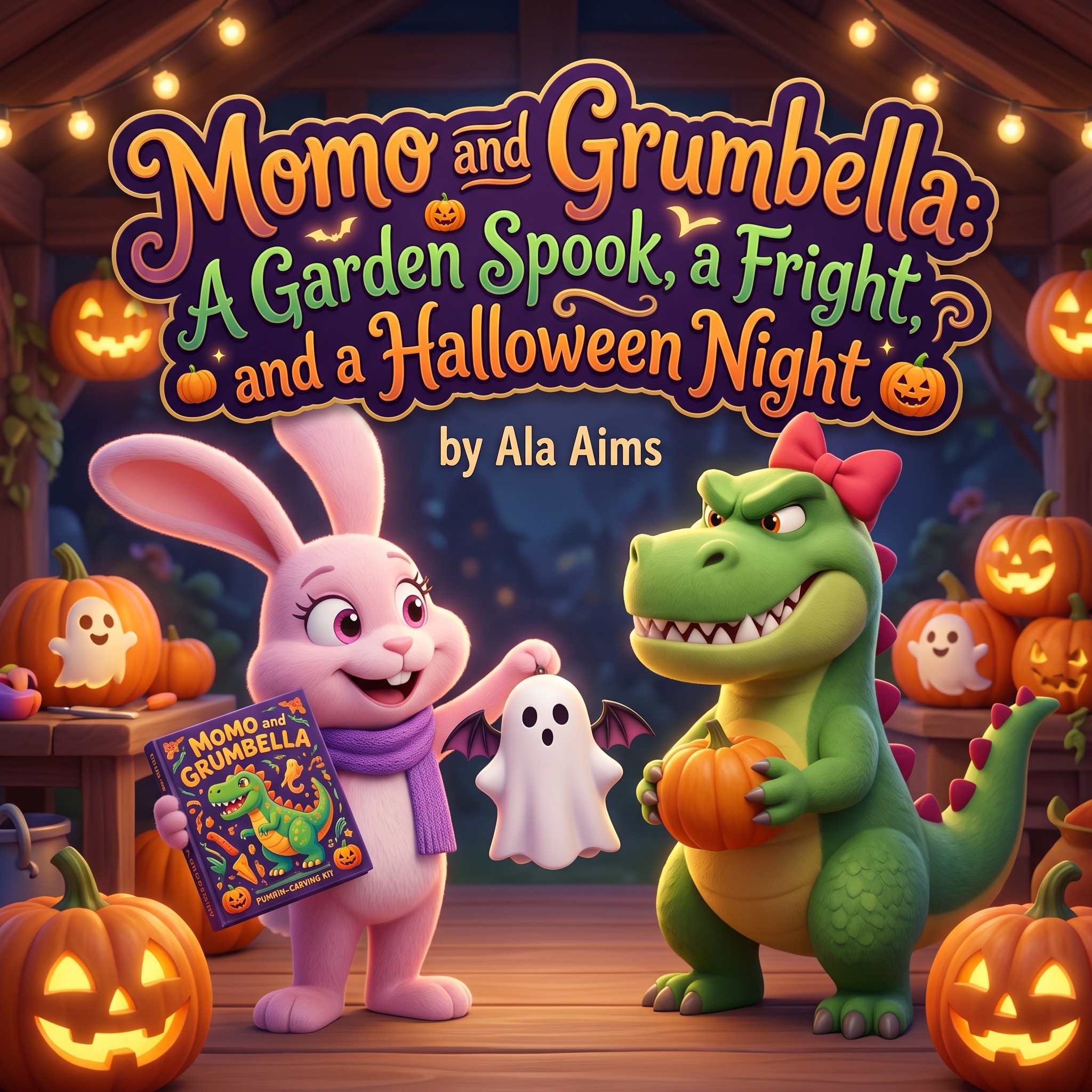
Buy this Book:
Momo and Grumbella: A Garden Spook, a Fright, and a Halloween Night
by Ala Aims
Listen to this review
Momo and Grumbella: A Garden Spook, a Fright, and a Halloween Night is a short Halloween adventure built around a familiar pleasure of the season: discovering that frightening noises and shapes often have harmless explanations. Momo, a curious bunny, and her grumbling companion Grumbella encounter a rattling pumpkin patch, a scratching shed, and a ghostly shape before stumbling on a more meaningful mystery—a lost baby bat. The story’s strongest qualities are its clear child-friendly progression, its playful friendship, and its reassuring idea that courage is easier when shared.
The early episodes establish a comic pattern. A noise raises alarm; Momo and Grumbella investigate; the apparent threat turns out to be a squirrel tangled in paper bats, a branch scraping the shed, or a sheet caught in the trees. These reversals give the story a gentle, repeatable rhythm suited to young listeners. The suspense is carefully limited: the characters are startled, but the explanations arrive quickly, and the scare never becomes genuinely menacing. On a Halloween read-aloud, sound effects such as “RATTLE!”, “SCRAAAAATCH!”, and “BOOOOOO!” offer obvious opportunities for performance and participation.
The humor comes less from elaborate jokes than from the contrast between the two friends. Momo is drawn toward each mystery, while Grumbella insists she is unafraid even when her feet leave the ground. Her claim that she was “jumping with excitement,” and her later attempt to blame her rumbling stomach on a ghost or monster, make her bluster an appealing running joke. Momo’s teasing remains affectionate rather than cruel, and the pair’s familiar back-and-forth gives the episodes a sense of companionship. Grumbella’s reluctant admission that she “tolerate[s] Halloween,” while wearing the ghost sheet, is a neat visual and verbal payoff to that comic resistance.
The story gains emotional weight when the tiny jack-o’-lantern reveals a frightened baby bat. Until that point, the scares are mostly puzzles to solve; the bat’s separation from his family gives Momo and Grumbella someone vulnerable to help. Grumbella’s “Stay close” marks a useful shift: she is still scared, but she accepts responsibility and joins the search. Her loud call brings the bat family back, and the concluding exchange—“It’s easier to be brave with a friend by your side”—states the book’s theme plainly. The lesson is direct, but it follows from the characters’ actions rather than appearing without preparation.
Structurally, the sequence is easy to follow and well matched to a young audience: comic scares build toward a more consequential problem, followed by reunion and a festive ending. The search behind the shed, above the pumpkin patch, and beneath the apple tree gives the rescue a simple forward motion. The story also returns to its opening Halloween celebration, now including the bat family, so the resolution feels communal. Its originality is modest. Pumpkins, a ghost costume, a lost bat, and a “not scared” companion are familiar children’s-book ingredients, and the repeated harmless scares are predictable. The fresh appeal lies primarily in the banter and in Grumbella’s gradual shift from reluctant participant to helper, not in an unfamiliar premise.
The manuscript’s main weakness is its uneven prose editing. Several errors and awkward constructions interrupt the otherwise accessible storytelling: “There is always scary sounds” should be grammatically revised; “Momo bursted out” is incorrect; and “Momo’s ears popped straight up” is an unusual expression where “perked up” would read more naturally. Capitalization, apostrophes, and dialogue punctuation also vary, as in “momo,” “Your silly,” and the inconsistent punctuation around the characters’ spoken lines. Some sentences are choppy or imprecise, including the description of the growing pumpkin before it falls. These issues matter especially in a picture book, where short text is often read aloud and each sentence carries considerable weight. A careful copyedit would improve fluency without changing the story’s simple voice.
The supplied text says that the story and illustrations were created with the assistance of artificial intelligence using BookBudKids. That disclosure is useful context, but the material provided here does not include the illustrations themselves, so their contribution to the book’s visual storytelling cannot be assessed. Nor does the supplied text show the finished page design; the contents list and page references alone are not enough to judge how the narrative is paced across spreads. The review therefore rests on the words available, which are lively in their sound effects and character exchanges but would benefit from more consistent polishing.
This will likely suit younger children who enjoy mild Halloween frights, animal characters, comic repetition, and a reassuring ending. It may be a weaker fit for readers seeking a more surprising plot, more layered language, or genuinely suspenseful scares. For families looking for a gentle seasonal story about friendship and helping someone who is afraid, Momo and Grumbella offers a warm, easy-to-follow adventure; its charm is real, though a thorough line edit would make that charm more consistent.
Share-ready review images
Download square and vertical images for posts, stories, newsletters, and media kits.
For authors
Want a review page like this for your book?
Upload your manuscript, choose a review tier, and get a permanent public editorial review page you can share with readers.
Review My Book← Back to Reviews
