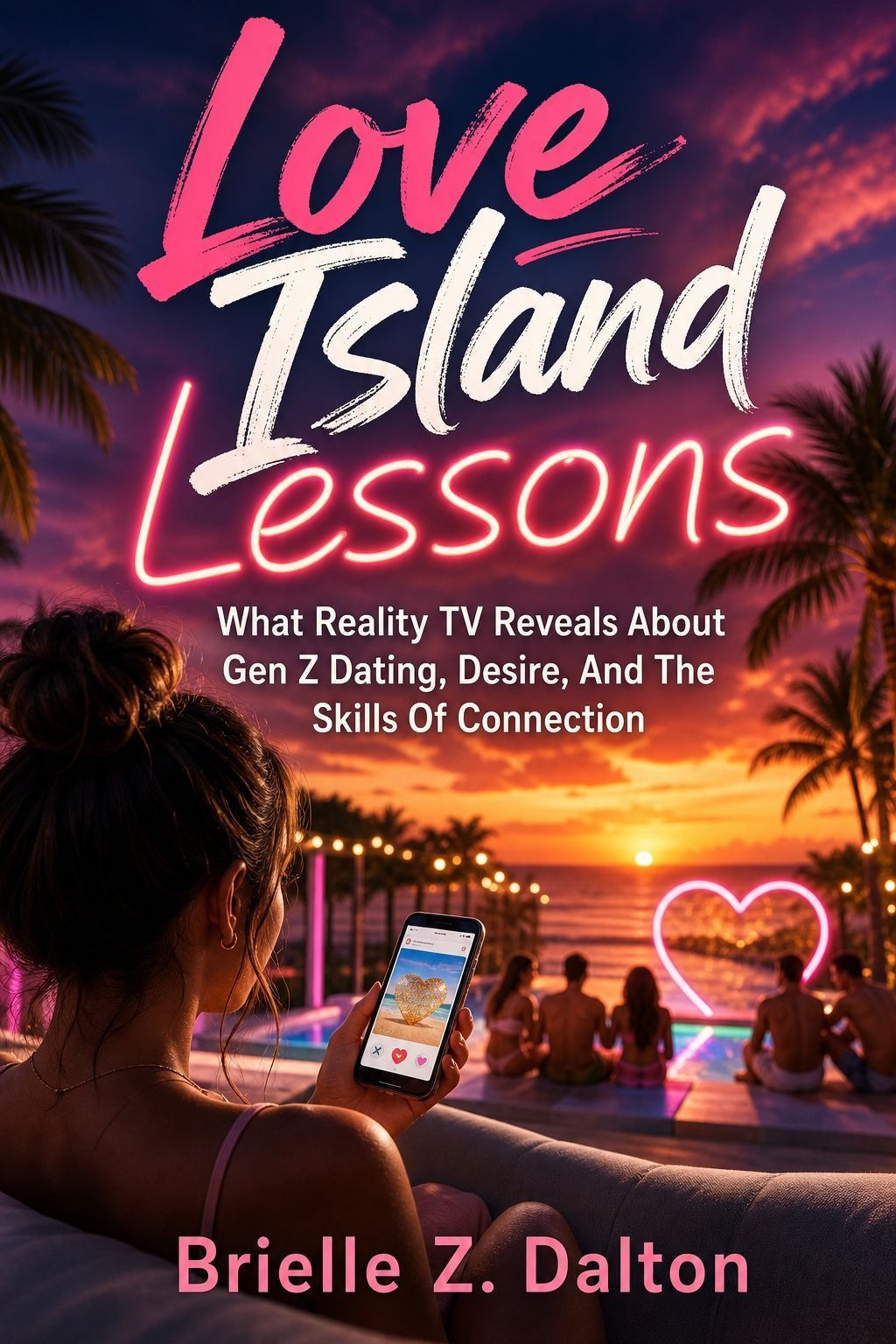
Buy this Book:
Social Science / Popular Culture (SOC022000)
Love Island Lessons
by Brielle Z. Dalton
Listen to this review
Love Island Lessons is less a fan book about a reality series than a cultural essay about what dating has become for Gen Z, and that is both its main strength and its main limitation. Across ten chapters, it uses Love Island as a kind of social laboratory, arguing that the show matters not because it is frivolous, but because it makes visible the logic of contemporary romance: visibility, evaluation, performance, comparison, and the pressure to appear desirable while remaining readable. The book’s central premise is persuasive from the start. In Chapter 1, “Why Love Island Matters,” the text frames the villa as an environment that turns “private behavior” into public data, a formulation that gives the book an immediate critical purpose. It is strongest when it treats the show not as escapist entertainment but as a concentrated version of everyday dating culture.
The prose is clear, intellectually ambitious, and consistently organized around a chain of linked ideas. The chapter structure itself is a major asset. “The Dating Landscape Gen Z Inherited,” “Attraction in the Age of Performance,” “Communication Is the New Chemistry,” and “Gender Scripts, Power, and the Politics of Desire” all build a coherent argument from different angles without losing sight of the larger thesis. The book has a real gift for conceptual translation: it takes familiar, hard-to-name experiences—ghosting, overexplaining, strategic coolness, the fear of seeming needy—and gives them sharper language. Chapter 5 is especially effective in distinguishing politeness from clarity, and in showing how self-protective speech can create confusion even when it sounds considerate. That kind of analysis is useful because it does not merely moralize; it identifies the mechanics of modern dating talk.
One of the book’s best qualities is its steady attention to the gap between being desired and being known. Chapter 4 develops this contrast with real precision, arguing that desire can be sparked by style, charisma, or a curated online presence long before there is any actual knowledge of character. Likewise, Chapter 9 offers one of the book’s most convincing distinctions: mutual connection has rhythm and memory, while intensity can be loud without being stable. These are not novel claims in a broad cultural sense, but the book handles them with enough specificity to feel earned. It repeatedly returns to a valuable insight: many contemporary daters are not failing because they lack feeling, but because the conditions around them reward quick judgments and emotional defensiveness.
The text is also at its strongest when it links the show’s format to broader social pressures. Chapter 3, “The Love Island Machine,” is particularly effective at explaining how the villa compresses attraction and conflict, while Chapter 8 broadens that analysis by showing that dating is always also a group activity, shaped by gossip, loyalty, and social approval. The book understands that romance does not happen in isolation; it is filtered through witness, reputation, and the fear of looking foolish in front of others. That awareness gives the argument real breadth. The result is a book that can be read as media criticism, social commentary, and a dating manual at once.
At the same time, the book’s reliance on repetition is also a weakness. Because it is built around a single governing idea—that Love Island dramatizes the social conditions of modern dating—the chapters sometimes circle the same insights in slightly different language. The discussion of visibility, performance, and emotional caution is compelling, but it recurs so frequently that some sections begin to feel less cumulative than reiterative. Readers looking for a more sharply differentiated progression from chapter to chapter may find the middle of the book somewhat elastic. The argument remains coherent, but it does not always advance with the force suggested by the chapter titles.
Another limitation is the book’s tendency toward abstraction. It is rich in interpretive framing, but the supplied content offers relatively few concrete scenes, named contestants, or close readings of particular Love Island moments. That choice gives the book a broad applicability, but it also keeps it at a certain distance from the messier pleasures of reality television itself. The reader is told a great deal about what the show reveals, yet less about the specific people or episodes through which those revelations emerge. This makes the book feel analytically confident, but occasionally more like a theory of dating culture than a textured account of the series.
The appended materials suggest the book wants to be practical as well as interpretive. The “Appendix: A Field Guide to Better Dating” promises questions to ask before, during, and after a date, signs of emotional availability and avoidance, and a self-audit for communication habits. Even without the actual appendix text, the design indicates a useful bridge between reflection and application. Still, based on the chapters provided, the book seems best suited to readers who are open to reflective, framework-driven advice rather than those looking for narrative entertainment or highly granular dating tactics.
There is also a faint risk that the book’s explanatory lens is so encompassing that it can make all dating behavior look overdetermined by social forces. Its attention to scripts, platforms, and audience pressure is often insightful, but readers wanting a more playful, spontaneous, or less diagnostic approach to romance may find the tone a little heavy. The book is most compelling when it acknowledges ambiguity rather than trying to resolve it too neatly; fortunately, many of the strongest chapters do exactly that.
Overall, Love Island Lessons is an intelligent, readable, and timely meditation on how dating works under conditions of surveillance, comparison, and public interpretation. It will be most valuable to readers interested in media criticism, Gen Z culture, and the emotional mechanics of modern dating, especially those who appreciate analysis that treats reality TV as socially diagnostic rather than trivial. It is less likely to satisfy readers seeking close show-specific recap, conventional relationship advice, or a lighter cultural take, but for its intended audience it offers a thoughtful and useful lens on contemporary intimacy.
Share-ready review images
Download square and vertical images for posts, stories, newsletters, and media kits.
For authors
Want a review page like this for your book?
Upload your manuscript, choose a review tier, and get a permanent public editorial review page you can share with readers.
Review My Book← Back to Reviews
