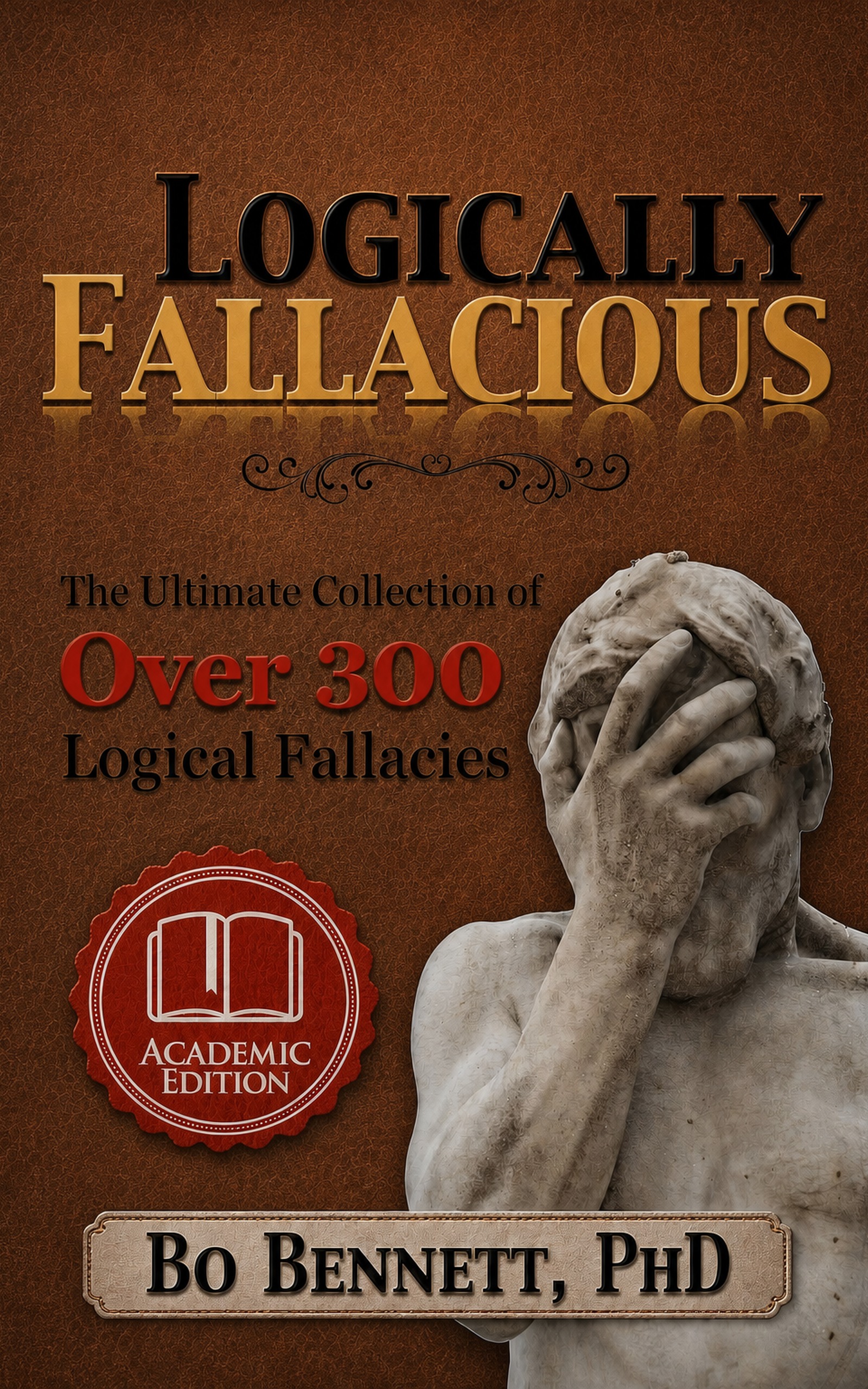
Buy this Book:
Non-Fiction
Logically Fallacious
by Bo Bennett, PhD
Listen to this review
Logically Fallacious takes an expansive, practical approach to reasoning: its contents list runs from familiar errors such as ad hominem and false dilemma to less commonly discussed labels including “Alphabet Soup,” “Motte-and-Bailey Fallacy,” and “Unreasonable Inclusion Fallacy.” The book’s central ambition is not merely to name mistakes in argument, but to help readers recognize how they work in everyday exchanges. Its most effective entries combine a compact definition with a logical form, examples, explanation, exceptions, and a tip for readers. This repeated structure makes a daunting subject navigable and gives the book the character of a reference work as much as a guide to critical thinking.
The opening material establishes useful boundaries. It distinguishes formal from informal fallacies, logical fallacies from cognitive biases, and errors in reasoning from factual errors. That last distinction is especially important: a claim can be false without its reasoning being fallacious, and a fallacious argument can still arrive at a true conclusion. The author returns to such cautions throughout. In the entry on ad hominem (guilt by association), for instance, an association alone is not enough to establish a person’s beliefs; the text also allows that a close, causally relevant connection could change the assessment. These qualifications help prevent fallacy-spotting from becoming a simplistic game of attaching labels to opponents.
The book’s strongest teaching tool is its range of concrete examples. The explanation of affirming the consequent turns on a memorable conditional about taxes and having more money, then supplies alternative explanations for the increased spending money. The discussion of the argument from silence uses Jay and Silent Bob to show why an unanswered accusation proves little. Elsewhere, the “argument of the beard” illustrates how a continuum can lack a precise boundary without making its extremes indistinguishable. Such examples translate abstract principles into recognizable situations, while the accompanying exceptions often show when an apparently similar argument might be valid. The author’s recurring advice to ask what evidence would support a claim, clarify the meaning of a term, or distinguish possibility from probability is practical rather than merely terminological.
The voice is lively and deliberately irreverent. Jokes about “bedroom golf,” “obligate anaerobes,” and a cure for baldness through “stupidity” keep long stretches of definitions from reading like a logic textbook. The conversational tone may also reassure readers who find formal logic intimidating; the section on categorical syllogisms explicitly tells them not to feel lost. Yet the humor is not always a neutral aid. Some examples ridicule their subjects or use loaded descriptions, and the discussion of appeals to heaven, religious belief, and supernatural claims can feel less even-handed than the book’s general emphasis on charitable interpretation. The author sometimes draws firm philosophical conclusions where a reader might prefer a narrower explanation of the reasoning error. That does not invalidate the instructional method, but it can make the book feel argumentative in its own right.
Its breadth is both a major strength and a limitation. The contents encompass hundreds of named fallacies, a section on cognitive biases and heuristics, techniques for exposing fallacious reasoning, types of lies, practice situations, and questions and answers. The FAQ topics—among them whether belief in God is a fallacy, how to respond to endless demands for “why,” and whether fallacy detection can hamper creativity—suggest an effort to address the complications of applying these concepts outside tidy examples. The later response about protests in 2020 is a useful instance of that approach: rather than simply declaring “protests” or “riots” the correct label, it distinguishes riots as subsets of protests and identifies ambiguity as a possible source of confusion.
At the same time, the sheer number of entries risks flattening differences in status and importance. The text itself identifies some entries as original labels or notes that it could find no academic sources for them, while other entries cite works in logic, philosophy, and psychology. Readers may therefore need to treat the catalogue as a mixture of established concepts, useful informal labels, and the author’s own classifications—not as a uniformly settled taxonomy. Some explanations are necessarily compressed, and a quick formula can encourage readers to diagnose an argument before considering context. The repeated exceptions and tips mitigate this problem, but the book’s length and density may still make it more useful for dipping into than reading straight through.
Logically Fallacious is best suited to readers who want an accessible, example-rich introduction or desk reference for analyzing arguments in conversation, media, and public debate. Its structured entries, practical cautions, and willingness to distinguish bad reasoning from mere disagreement make it a valuable resource, particularly for self-directed learners and educators seeking discussion prompts. Readers looking for a tightly bounded academic treatment, a consistently restrained tone, or a definitive scholarly classification of every named fallacy may find its broad taxonomy and polemical humor less satisfying. Overall, it is a substantial and often engaging guide whose greatest value lies in teaching readers to ask better questions—not simply to collect labels for other people’s mistakes.
Share-ready review images
Download square and vertical images for posts, stories, newsletters, and media kits.
For authors
Want a review page like this for your book?
Upload your manuscript, choose a review tier, and get a permanent public editorial review page you can share with readers.
Review My Book← Back to Reviews
