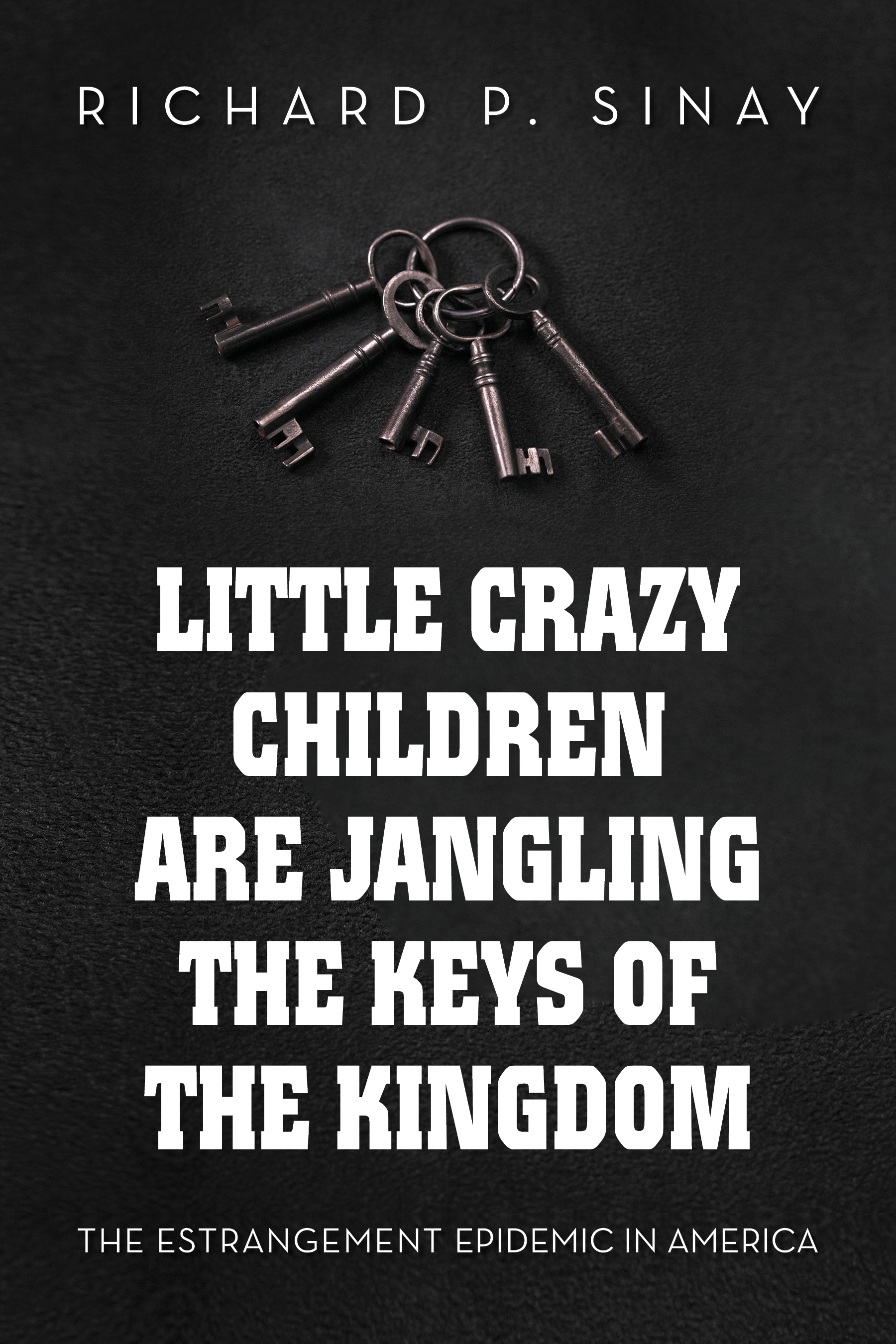
Self Help/Psychology
Little Crazy Children are Jangling the Keys of the Kingdom
by Richard P. Sinay
Listen to this review
Richard P. Sinay’s Little Crazy Children Are Jangling the Keys of the Kingdom: The Estrangement Epidemic in America begins from a wound that is both personal and plainly unresolved. Sinay writes as an estranged father and grandfather who wants to explain the pain of losing contact with his children, offer guidance to other estranged parents, and persuade adult children to consider the consequences of cutting ties. The book’s strongest material comes from that firsthand account: it makes the experience of estrangement concrete, even as its broader claims about families and generations are less persuasive.
The three-part structure reflects the author’s stated aims. Part I addresses people who estrange relatives, Part II turns to those who have been estranged, and Part III defends Sinay’s parenting and grandparenting. The progression moves from argument, through counsel, to personal testimony. Chapters on the effects of estrangement and its stages of grief describe sleeplessness, self-questioning, ambiguous loss, and the struggle to accept a changed family life. Sinay’s account of moving closer to his son’s family, traveling to Ireland, and spending time with his grandchildren gives these ideas a particular human scale. His recollections of playing “Grandpa Monster,” teaching golf, and taking the children for ice cream are among the book’s most affecting passages because they show what he misses rather than merely naming the loss.
The manuscript also has a useful impulse toward complexity. Chapter 8 recognizes that estrangement can be justified in cases involving abuse, neglect, incest, or other serious harm; Chapter 11 acknowledges that responsibility is shared and that estranged parents may need to identify a “kernel of truth” in a child’s complaints. Sinay draws on Joshua Coleman’s writing, research cited in the Works Cited, and Brené Brown’s parenting manifesto. Chapter 14’s suggestions—journaling, seeking support, learning self-compassion, and consulting a therapist familiar with estrangement—are among the book’s most constructive offerings. They shift the focus from proving who is right toward finding ways to live with grief and uncertainty.
Yet the book’s stated interest in understanding estrangement is repeatedly overtaken by its defense of the author’s own position. In Part III, Sinay recounts the sacrifices he and his ex-wife made: working multiple jobs, providing educational opportunities, and supporting their son’s golf ambitions. These memories establish how he understands his parenting, but they cannot, by themselves, establish how his children experienced it. Sinay acknowledges that the narrative is his version, then often treats that version as decisive. He describes his children as acting for “inexplicable” reasons, attributes estrangement to their generation’s values, and speculates about his son’s “genetic makeup.” The result is a tension between the book’s call for mutual accountability and its limited willingness to consider what the absent family members might say.
That tension affects the book’s reach. The chapters meant to address adult children sometimes frame estrangement as cruelty, bullying, or an epidemic, while describing many objections as trivial or “unjustified.” Sinay does allow for serious reasons to cut contact, but his repeated comparisons to witch hunts and his broad claims about Millennials being narcissistic risk turning a complicated family decision into a generational indictment. The text cites studies and expert commentary, but the leap from selected research to claims about the character of a generation is not sufficiently qualified. The argument would be stronger if it distinguished more carefully between population-level findings, personal interpretation, and conclusions drawn from one family’s history.
Some advice also needs more caution. Chapter 5 argues that estranged parents deserve an explanation and an opportunity to repair the relationship. That desire is understandable, but the book’s own discussion of abuse shows why communication or reconciliation may not be safe or appropriate in every case. Likewise, the suggestion to remain in contact with grandchildren may be valuable in some circumstances, but it could conflict with boundaries set by parents. A fuller treatment would recognize that no single approach—explanation, mediation, continued contact, or forgiveness—fits every estrangement.
As prose, the book is direct and accessible, with a personal, conversational voice that can make its emotional subject matter easy to follow. Its chapter-by-chapter organization and recurring references to Coleman give readers a clear route through topics including grandparents’ roles, family change, grief, and self-help. At the same time, key points recur often, and the argument sometimes circles back to the author’s claim that he was a good parent without gaining much new insight. The supplied text also contains frequent typographical, grammatical, and formatting errors, which interrupt the reading and weaken the presentation of a work that relies heavily on careful distinctions.
Little Crazy Children Are Jangling the Keys of the Kingdom is most valuable as a candid account of one man’s estrangement and as a source of recognition for readers who feel isolated by a similar loss. Its practical suggestions may help some estranged parents begin to care for themselves. Readers seeking a balanced guide to why adult children cut contact, however, may find the argument too invested in assigning blame and too ready to generalize from one perspective. This book is best suited to estranged parents and grandparents looking for personal testimony and emotional solidarity, especially those willing to read its conclusions critically rather than as a comprehensive account of every family’s experience.
Share-ready review images
Download square and vertical images for posts, stories, newsletters, and media kits.
For authors
Want a review page like this for your book?
Upload your manuscript, choose a review tier, and get a permanent public editorial review page you can share with readers.
Review My Book← Back to Reviews
