
Buy this Book:
Political Science / Political Process / Campaigns & Elections (POL008000)
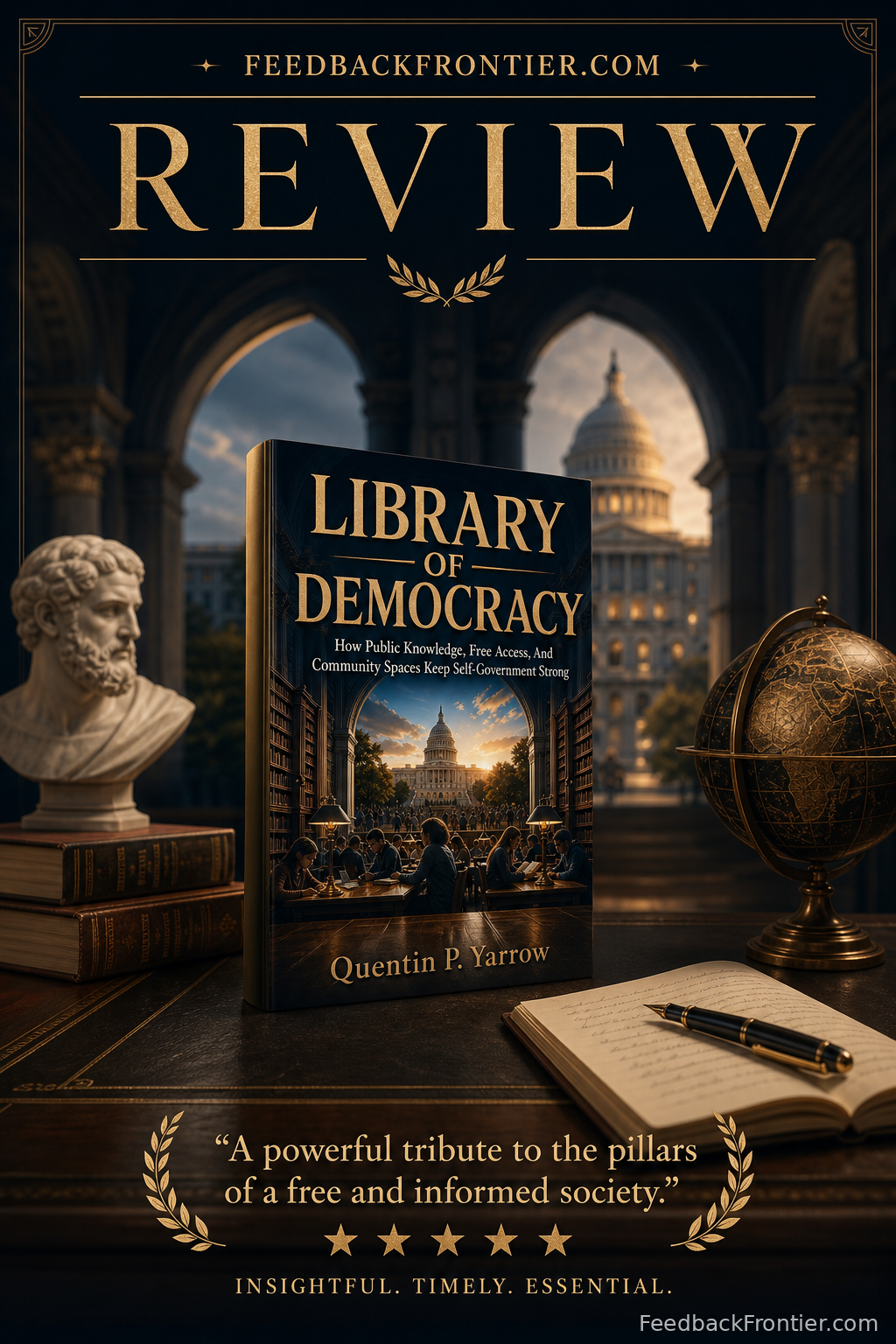
Library of Democracy
by Quentin P. Yarrow
Listen to this review
Library of Democracy is an earnest, architecturally coherent meditation on the civic meaning of libraries, and its strongest quality is the seriousness with which it treats an institution many readers may still take for granted. Across its ten chapters, the book argues that democracy is not merely a matter of voting but a sustained practice of participation, and that libraries help make that practice possible by supporting access, literacy, memory, public space, and civic trust. The result is less a conventional history than a public philosophy of the library: cumulative, declarative, and frequently persuasive.
What first stands out is the book’s clarity of purpose. Chapter 1, “Why Democracy Needs Shared Institutions,” lays the conceptual groundwork with admirable discipline. Its insistence that democratic life depends on “attention, judgment, patience, and a willingness to listen” gives the book a strong moral and civic frame, and it usefully broadens the reader’s sense of what participation entails. The argument is repeatedly anchored in concrete examples: reading a budget, comparing sources, understanding a public meeting agenda, or locating historical context. Those are not ornamental details. They help keep the book from drifting into abstraction, and they show how the author imagines democracy operating at the level of daily competence.
The book is especially effective when it defines libraries not just as repositories but as active civic instruments. Chapter 2, “The Library as a Democratic Idea,” makes a compelling case that public libraries emerged as deliberate responses to exclusion, shifting access from privilege toward a civic expectation. The distinction it draws between ownership of information and access to information is one of the book’s most useful conceptual moves. Likewise, Chapter 3’s discussion of free access, privacy, and the difference between libraries and commercial information systems is timely and convincing. The contrast between a library that exists to help people “ask better questions” and a commercial platform organized around attention and extraction gives the book a sharp ethical edge.
Another strength lies in the book’s attention to inclusion as something more than symbolic diversity. In Chapter 3, the discussion of multilingual materials, accessibility tools, and representation across authors of color, Indigenous writers, LGBTQ+ creators, disabled authors, and religious minorities is concrete and institutionally grounded. The book does not merely celebrate inclusion in the abstract; it explains why signage, screen-reader compatibility, tactile materials, plain-language navigation, and collections reflecting local communities are part of democratic infrastructure. That is one of the book’s most durable contributions: it reframes accessibility as a core condition of public life rather than a special accommodation appended afterward.
Chapter 4, “Libraries as Schools of Civic Learning,” is among the most convincing sections because it traces library value across the life cycle. Its account of story hours, early literacy, adolescent privacy, adult re-entry into reading, writing help, and research support gives the book breadth without losing focus. The chapter also effectively links these services to civic agency: learning to navigate forms, evaluate sources, and use databases becomes a precondition for participating in schools, workplaces, public meetings, and neighborhood life. The same is true of Chapter 5, which presents libraries as stewards of shared memory. Its emphasis on local newspapers, maps, flyers, oral histories, and ephemeral records underscores an important point: historical truth depends not only on major archives but on the preservation of ordinary community evidence.
The prose is generally strongest when it moves through sustained, reasoned accumulation. The book often proceeds by adding layer upon layer of argument—trust, then access, then memory, then public space—until the civic role of the library seems almost unavoidable. Chapter 6’s account of the library as a “free and welcoming third place” is a fine example. It thoughtfully treats design, seating, quiet, signage, and the absence of purchase pressure as democratic signals. Chapter 7 similarly gives a sober and useful account of disagreement, arguing that libraries can model civil discourse without demanding false consensus. This section is notable for its restraint: it does not romanticize conflict, but it does insist that disagreement, when governed by respect and evidence, is part of healthy public life.
Still, the book’s limitations are real. Its prose tends toward repetition, and its thematic architecture, while clear, is also highly formulaic. Many chapters advance in similar cadences—define the civic problem, describe the library’s corrective role, then reaffirm democracy’s dependence on that function. That structure gives the book coherence, but it can also flatten surprise. Readers looking for vivid narrative, case studies, or a more distinctive historical texture may find the argument somewhat airless. The material is thoughtful, but it is seldom revelatory in stylistic terms.
There is also a noticeable tendency to idealize the library as a morally exemplary institution. The book acknowledges barriers, exclusion, defunding, and polarization in Chapters 8 and 9, yet even there the tone often returns to institutional confidence. That confidence is understandable, but it can make the analysis feel less contested than the subject warrants. Chapter 8 usefully maps transportation, time, language, disability, digital access, and outreach barriers; however, because the provided text remains largely conceptual, these pressures are described more than dramatized. Similarly, Chapter 9 identifies censorship, surveillance, and budget pressure clearly, but the treatment is more schematic than probing. Readers hoping for a sharper examination of internal contradictions, tradeoffs, or failures in library practice may wish for more friction.
Chapter 10 and the Appendix suggest practical usefulness, especially in the suggested metrics for evaluating library impact on democratic participation, but the excerpted material remains high-level. The final chapters promise resilient, inclusive service and advocacy tools, yet the reader is left with principles more than procedures. That is not a flaw if the book is intended as a civic framework; it is a limitation if one seeks a hands-on guide.
Library of Democracy will be most valuable to librarians, educators, civic leaders, community organizers, and readers interested in democratic theory, public institutions, and cultural policy. It is especially well suited to those who want a principled defense of libraries as civic infrastructure. Readers seeking narrative history, sharper empirical evidence, or a more unpredictable literary voice may find it less satisfying. On balance, this is a thoughtful and timely work, but best recommended to readers prepared for argument, not storytelling.
Share-ready review images
Download square and vertical images for posts, stories, newsletters, and media kits.

For authors
Want a review page like this for your book?
Upload your manuscript, choose a review tier, and get a permanent public editorial review page you can share with readers.
Review My Book← Back to Reviews
