Christian Children/Young Adult/Devotional/Inspiration or Christian Fantasy
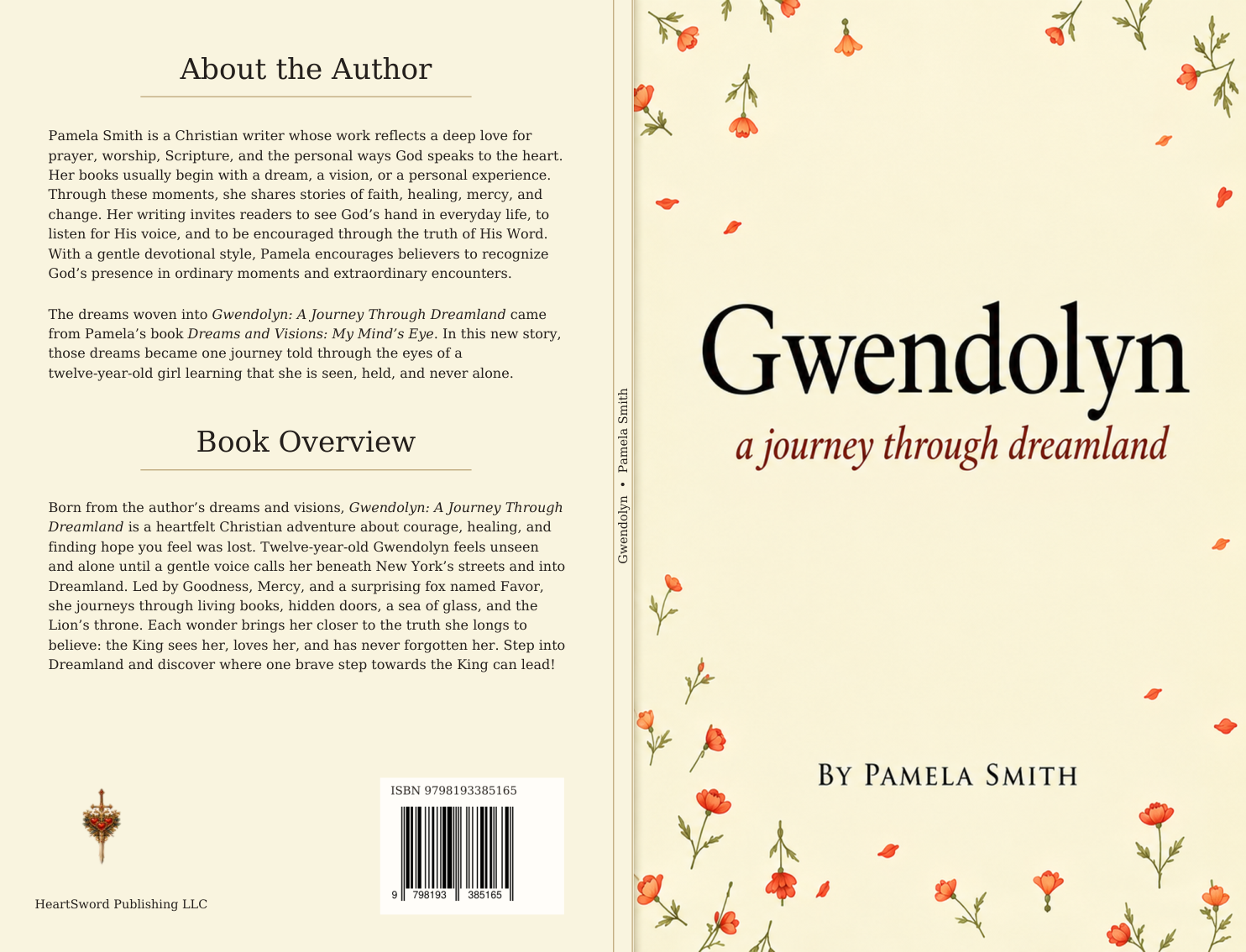
Gwendolyn
by Pamela Smith
Listen to this review
Gwendolyn: A Journey Through Dreamland turns a child’s perilous circumstances into a sequence of symbolic encounters about faith, fear, belonging, and healing. Twelve-year-old Gwendolyn is homeless, hungry, and unsure whether anyone sees her. When she follows a voice through an open manhole, she enters a dreamworld of living books, a King’s table, a talking fox, a bridge, a garden, and a waterfall in the sky. The premise gives author Pamela Smith a clear emotional question to carry through the adventure: can Gwendolyn believe that she is known and loved, even when the help she needs has not yet arrived?
The book’s strongest moments arise when its imagery meets Gwendolyn’s concrete fears. At the table in Chapter 2, the Man with scars on his hands tells her, “You do not have to prove that you belong here. You only have to come hungry.” The line brings spiritual welcome into contact with the literal hunger established in the opening chapter, while the surrounding guests’ distractions—phones, mirrors, certificates, and books—give the scene a legible account of other forms of emptiness. Later, in Chapter 12, a tired soldier admits that he has watched so long he has forgotten “who was watching over me.” Gwendolyn’s own habit of staying alert makes his lesson about rest more than an abstract devotional point: it recognizes the strain of feeling unsafe.
Smith also builds a coherent symbolic vocabulary across the journey. Goodness goes ahead of Gwendolyn, Mercy stays close behind, and Favor appears in unexpected forms; together, they make the book’s theological ideas visible and easy for younger readers to follow. The golden key, the blue dress marked with Gwendolyn’s name, the bridge whose colors dim when people stop listening, and the stump putting out new leaves all reinforce recurring concerns with belonging, reconciliation, and renewal. The sea of glass offers one of the story’s more effective shifts in mood: Gwendolyn learns that loosening her body does not mean she will fall, and laughter becomes a small but meaningful sign of release.
The prose is direct and accessible, with short scenes, concrete details, and frequent questions that invite readers to share Gwendolyn’s uncertainty. The dream’s strange transitions—most notably the room becoming a record player, or a butterfly resting on a turtle beneath the water—supply moments of genuine imaginative oddness. Chapter 10 is particularly valuable because Gwendolyn’s role as a peacemaker is not presented as effortless. She initially shouts at the divided groups, sees the bridge turn gray, and has to return with a question and a willingness to listen. That stumble gives the lesson more credibility than a simple speech about kindness would have done. Her decision to leave the bridge and find a frightened girl also grows naturally from her own memories of being unseen.
The book’s principal limitation is that it often explains its symbols immediately after presenting them. Characters state the moral, Gwendolyn summarizes what she has learned, and the narration may then underline the meaning again. This devotional clarity will suit readers who want explicit Christian teaching, but it can flatten the dream’s mystery and make some encounters feel like illustrated lessons rather than scenes that develop independently. The repeated pattern—an unfamiliar image, Gwendolyn’s question, an answer from the King or a companion—creates a steady rhythm, but over twenty-one chapters it can become predictable. The book’s spiritual framework is also direct and specific: the King, the Father, the Son, and the Holy Spirit are identified plainly, and Scripture references anchor several scenes. Readers seeking religiously neutral fantasy or more interpretive ambiguity may find that approach less appealing.
There is a more consequential tension between Gwendolyn’s imaginative healing and her real-world danger. The story wisely does not claim that the dream supplies food or a home: in Chapter 21, Gwendolyn wakes on the sidewalk, and the narration states that she still needs somewhere safe to sleep and someone to help her. The bakery manager’s offer to contact a woman who helps children find safe places to stay gives the ending a practical direction, and Gwendolyn accepts his hand rather than running. Still, the book ends before that help is secured. Its emotional resolution is principally that Gwendolyn no longer feels forgotten, not that her circumstances have been resolved. That distinction is honest, though readers hoping for a fuller account of how a homeless child obtains safety may want more follow-through.
Gwendolyn’s growth is less a transformation into a fearless heroine than a gradual willingness to receive care: she rests beside the soldier, accepts that change may be slow, and chooses one safe step at the end. The ending’s return to the bakery curb gives the dream a useful frame, while the manager’s offer connects its spiritual reassurance to a human act of assistance. At times, however, the recurring assurances that the King sees and guides Gwendolyn leave little room for doubt or unresolved feeling. The story acknowledges fear and old hurt, but its consolations arrive with considerable certainty.
This is a gentle, openly Christian allegory best suited to young readers who enjoy dreamlike adventures and clear faith-based messages, as well as adults reading with them or looking for devotional discussion material. Its memorable images and compassionate emphasis on listening, rest, and belonging are real strengths. Readers who prefer subtle symbolism, complex fantasy plotting, or a more fully developed practical resolution to Gwendolyn’s homelessness may find the book less satisfying, but those seeking an accessible story of spiritual reassurance are likely to value its invitation to take the next step toward help.
Share-ready review images
Download square and vertical images for posts, stories, newsletters, and media kits.


For authors
Want a review page like this for your book?
Upload your manuscript, choose a review tier, and get a permanent public editorial review page you can share with readers.
Review My Book← Back to Reviews
