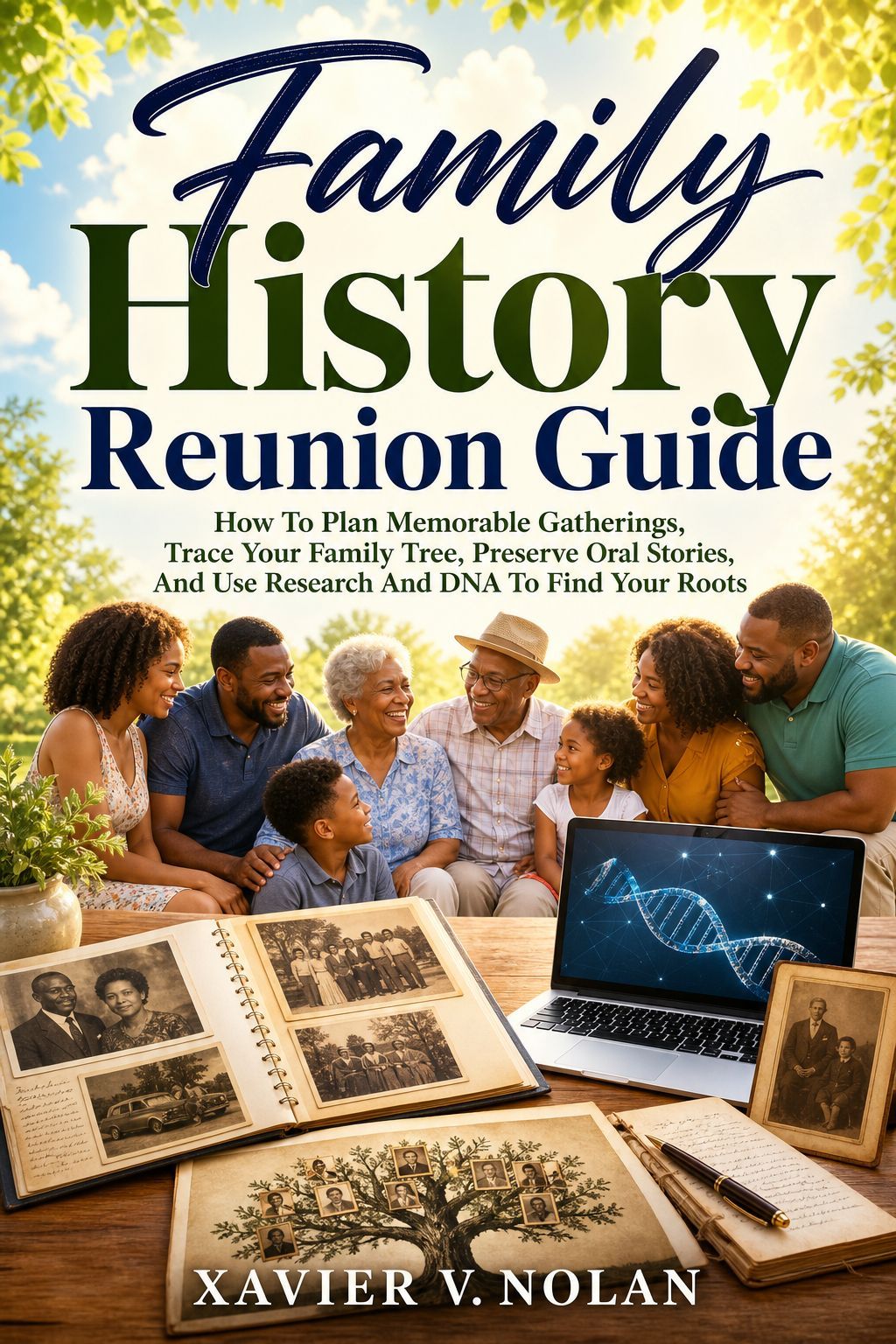
Buy this Book:
Reference / Genealogy & Heraldry (REF013000)
Family History Reunion Guide
by Xavier V. Nolan
Listen to this review
Family History Reunion Guide is a methodical, practical handbook that treats genealogy not as a hobby of nostalgia but as an act of disciplined stewardship. Across its ten chapters, it builds a persuasive case that family history is strongest when memory, records, and reunion planning work together rather than competing for authority. The book’s central idea is clear from the outset in Chapter 1, “Why Family History Matters,” where it distinguishes family lore from documented history without dismissing either. That balance gives the book its ethical seriousness: stories matter, but they must be labeled, tested, and preserved honestly.
The book’s greatest strength is its lucidity. It repeatedly breaks large tasks into manageable ones, whether it is “Starting with yourself and working backward” in Chapter 3, “Preparing thoughtful interview questions” in Chapter 4, or “Creating a master family history file or binder” in Chapter 9. The prose is patient and instructional, but not flat. It often anticipates common mistakes before they happen: treating a rumor as fact because it has been repeated often enough, assuming someone else already has the papers, or allowing digital files to scatter across devices and cloud accounts. Those are not abstract warnings; they are grounded in the everyday failures that sink family archives. The book’s insistence on labeling certainty, keeping source logs, and preserving both original and copied materials reflects real archival practice, translated into plain language for non-specialists.
Another notable strength is the way the guide handles family complexity. Chapter 1 acknowledges that households change through marriage, divorce, remarriage, adoption, foster care, and informal guardianship; Chapter 6 treats sensitive material such as name changes, estrangement, abuse allegations, and adoption papers with care rather than sensationalism; Chapter 8 extends that caution to DNA results, especially when they reveal unknown parentage or donor conception. This is one of the book’s most responsible features. It understands that family history can expose private truths, and it does not pretend that every discovery should be shared widely or immediately. The repeated emphasis on consent, restricted access, and respect for living relatives gives the book moral weight.
Structurally, the progression is sensible and cumulative. Chapter 2 establishes goals for reunion and research; Chapter 3 builds the family tree; Chapter 4 gathers oral history; Chapter 5 designs the reunion environment; Chapter 6 collects materials; Chapter 7 verifies them; Chapter 8 adds DNA evidence; Chapter 9 organizes everything into a lasting record; and Chapter 10 looks beyond the event to ongoing stewardship. This sequence mirrors the actual lifecycle of a family history project. It is especially effective because the book does not treat the reunion as the endpoint. Instead, it frames it as a catalyst for a longer archival responsibility. The appendix, with its reunion planning checklist, oral history questions, family tree and source log templates, and preservation checklist, reinforces that utilitarian purpose.
The guide is also original in its tone, if not in its basic subject matter. Family history manuals are common, but this one consistently links genealogy to family relationship-building. Chapter 2’s discussion of goals—celebration, research, preservation, or all three—recognizes that not every gathering must serve the same function. Chapter 5 develops that idea by matching location, schedule, and format to the reunion’s purpose, rather than assuming a one-size-fits-all model. Similarly, Chapter 10’s advice on appointing a point person or committee is practical in a way that many family projects desperately need. The book understands that records do not preserve themselves; people do, and only if responsibilities are clearly assigned.
Its most persuasive passages are those that combine emotional intelligence with procedural detail. The chapter on interviews, for example, advises readers to ask open-ended questions, listen for names embedded in anecdotes, and capture both what a speaker knows firsthand and what they have only heard secondhand. That advice is sound, but it is also humane. The book never treats relatives as raw data sources. It recognizes that some of the best memories emerge casually, that discomfort can silence important testimony, and that a person’s hesitation may be as meaningful as their answer. In that sense, the guide understands family history as a social practice, not merely a research method.
That said, the book’s strengths are also the source of its limitations. It is decidedly instructional and repetitive, which makes sense in a manual but may frustrate readers looking for narrative momentum, case studies, or a more interpretive approach to genealogy. The chapters often restate the same principles—label certainty, record sources, protect privacy, organize files—in slightly different forms. For a beginner, that repetition is reassuring. For an experienced family historian, it may feel overextended. The result is a book that is more handbook than compelling read, and its utility depends on whether the reader wants guidance or literary texture.
There is also a narrowness to its emphasis. The title suggests a broader reunion-centered framework, but the material is heavily weighted toward method: forms, logs, permissions, archiving systems, and verification procedures. Readers hoping for a more social or cultural treatment of family reunion traditions may find less here than expected. Likewise, while the book thoughtfully addresses DNA, it remains introductory rather than technical. It explains autosomal, Y-DNA, and mitochondrial testing clearly, but readers seeking advanced genetic genealogy strategy will need more specialized resources.
Even so, the book’s limitations do not undercut its usefulness; they clarify its audience. Family History Reunion Guide is best suited to families beginning a shared history project, reunion planners trying to move beyond casual reminiscing, and amateur genealogists who need a clear system for turning memories, documents, and test results into something durable. It is especially valuable for readers who want a practical, ethically minded framework for preserving family history without confusing lore with proof. If you are looking for a disciplined, accessible manual for organizing a reunion-centered archive, this book will be genuinely useful. If you want a more story-driven or advanced scholarly treatment, it is probably too procedural for your needs.
Share-ready review images
Download square and vertical images for posts, stories, newsletters, and media kits.
For authors
Want a review page like this for your book?
Upload your manuscript, choose a review tier, and get a permanent public editorial review page you can share with readers.
Review My Book← Back to Reviews
