Psychology
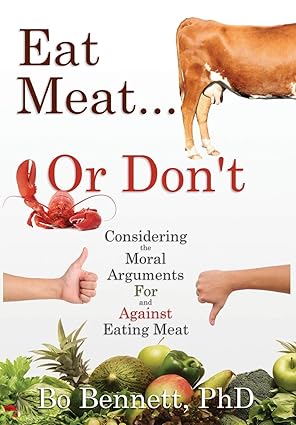
Eat Meat... or Don't: Considering the Moral Arguments For and Against Eating Meat
Listen to this review
Bo Bennett’s Eat Meat… or Don’t: Considering the Moral Arguments For and Against Eating Meat is a rare combination of rigorous argumentation, humane curiosity, and plainspoken wit. Reading this book feels like being guided through a long, often contentious conversation by a careful, well-informed interlocutor who refuses both dogmatism and rhetorical cheap shots. From the opening Preface—where Bennett’s snapping-turtle anecdote performs an elegant reductio—through the concluding “Eat Less Meat” counsel, the book is structured with a critic’s eye for clarity and a teacher’s instinct for pacing. The result is an accessible, persuasive, and unexpectedly generous inquiry into one of the most practical moral questions of our day.
Bennett organizes his material with admirable discipline. Part I, “Foundational Concepts,” lays the conceptual groundwork: linguistic shenanigans, the “in principle but not in practice” gambit, the Reductio Gambit, and the careful unpacking of what we mean by “eating meat.” These early chapters are more than academic preliminaries; they are practical tools. Bennett’s training in social and cognitive psychology pays off here—his chapters on motivated reasoning, affective versus social moral value, and the psychology behind hypothetical “name the trait” challenges give readers the cognitive equipment needed to have smarter, calmer conversations about diets, ethics, and cultural habits.
The centerpiece of Bennett’s ethical architecture is his extended treatment of sentiocentrism, a moral view he presents with refreshing modesty and clarity. Sentiocentrism, as Bennett explains in the chapters “A Closer Look at Sentiocentrism” and “Well-Being,” grounds moral concern in the capacity to experience well-being—an approach that is philosophically defensible, empirically attentive, and humane in tone. He links this theory to positive-psychology measures (PERMA) and to real-world moral dilemmas in a way that scholars and thoughtful lay readers will both respect.
What makes the book original is not just its synthesis of psychology and ethics, but the care Bennett takes to treat opposing arguments seriously. Part II and Part III, which stage arguments for and against the immorality of eating meat, are models of fair engagement: he grapples with the Argument from Marginal Cases, Peter Singer’s “2.0” formulation, the “Name the Trait” dialogues, and also the case for humane meat-eating, including pragmatic considerations like human well-being, ecological trade-offs, and cultural practices. Bennett’s treatment of the “clean meat” revolution is bright-eyed yet measured: he celebrates its promise in “The Coming ‘Clean Meat’ Revolution” while honestly acknowledging current technological limits. That balanced optimism is emblematic of the book’s tone throughout.
One of the greatest strengths of Eat Meat… or Don’t is its practical bent. Part IV’s reflections on reducing versus abstaining, and the chapter “Advice for Vegetarians and Vegans,” are full of argumentation-aware persuasion strategies that actually work in everyday contexts. The Q&A in Part VI is an especially valuable resource: Bennett answers the thorny questions—factory farming hypocrisy, comparative harms of plant versus animal agriculture, consent analogies, and the environmental calculus—concisely, compassionately, and with an eye toward persuading rather than humiliating interlocutors.
Stylistically, Bennett strikes a felicitous balance between academic precision and plain language. He can move comfortably from technical distinctions (metaphysical vs. phenotypical moral status, degrees of moral status, threshold concepts) to disarming cultural anecdotes (the dedication to farmers and the awkward “thank you, Jesus” joke) without losing the reader. His voice is confident but never condescending; the book frequently models the sort of intellectual humility it advocates.
If I have two gentle critiques, they are minor. Bennett acknowledges the book’s U.S.-centric statistics and apologizes for it; readers seeking a broader international data set may wish for more global sourcing. A handful of chapters invite deeper empirical engagement—particularly those discussing animal cognition and sentience—so readers who want exhaustive scientific literature reviews should supplement Bennett’s excellent conceptual account with current primary studies. These are not failures, only opportunities for an engaged reader to dig further.
Finally, the book’s impact is cumulative and moral in the best sense: it does not sermonize, but it steadily recalibrates the reader’s moral intuitions by improving conceptual clarity and exposing common rhetorical traps. Whether you identify as a committed omnivore, a flexitarian (like the author), a vegetarian, or a thoughtful skeptic, Bennett offers something valuable—better reasons, better questions, and practicable steps toward reducing harm. His concluding personal views—clear, thoughtful, and tethered to the book’s analysis—leave you with a humane, realistic, and compelling admonition: eat less meat.
In short, Bo Bennett has written a judicious, lively, and intellectually generous book that will serve as an excellent primer for anyone who wants to think more clearly about the ethics of eating. I strongly recommend Eat Meat… or Don’t to readers who want argumentation sharpened by psychology, moral theory grounded in wellbeing, and practical guidance that can actually change behavior. This is a book that helps us ask better questions—and gives us the tools to answer them.
Strongly recommended.
Share-ready review images
Download square and vertical images for posts, stories, newsletters, and media kits.
For authors
Want a review page like this for your book?
Upload your manuscript, choose a review tier, and get a permanent public editorial review page you can share with readers.
Review My Book← Back to Reviews
