Language Arts
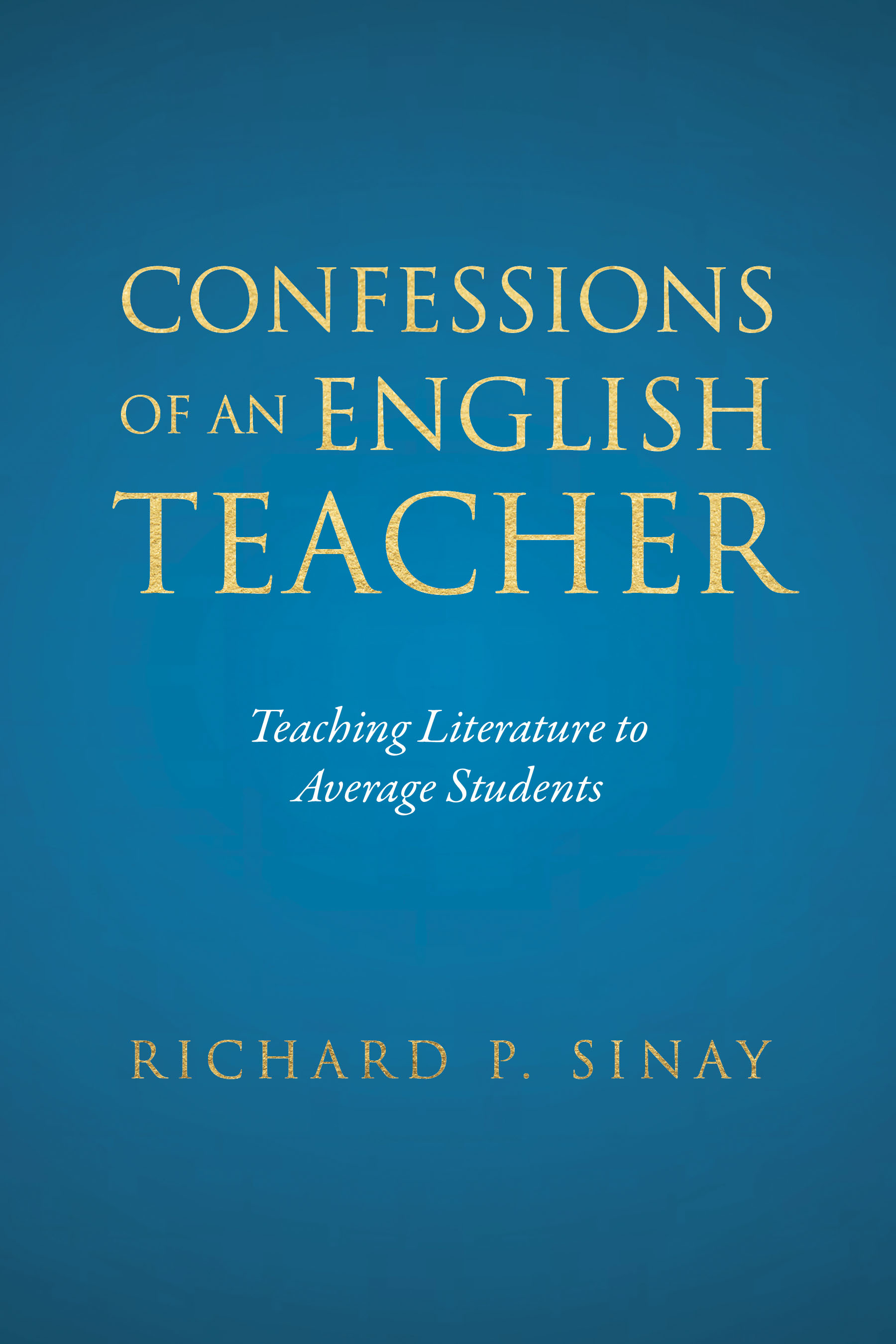
Confessions of an English Teacher Book 7
by Richard Sinay
Listen to this review
Confessions of an English Teacher: Teaching Literature to Average Students is less a conventional teaching manual than an experienced teacher’s sustained challenge to the assumptions behind secondary English instruction. Richard Sinay argues that the subject should be organized around literacy growth—not the preservation of a fixed canon or the accumulation of literary terminology—and that reading materials should be accessible enough to engage students without ceasing to challenge them. The book’s strongest contribution is the consistency with which it brings that principle into practical classroom decisions. Its chief weakness is that the confidence of its prescriptions often exceeds the evidence and qualification offered in the manuscript.
Sinay’s central proposal, the “Step-Ladder Approach” introduced in Chapter 3, is to select literature near students’ instructional reading level and to increase difficulty incrementally. Chapters 2, 5, and 6 develop the case: students are more likely to read work they find culturally relevant and linguistically manageable, and reading more is presented as the route to stronger literacy. This framework offers a useful corrective to teaching demanding texts merely because they are canonical. Sinay’s discussion of The Scarlet Letter and The Crucible makes the problem concrete: both may require substantial historical and linguistic preparation, and students can lose sight of the reading itself when the work feels remote. His counterexample, To Kill a Mockingbird, is described as readable, relatable, and challenging enough for tenth graders.
The book is also at its best when it turns this argument into classroom practice. Chapters 10–17 offer a sequence of approaches to novels, plays, poetry, short stories, nonfiction, and essays. In Chapter 12, Sinay describes teaching The Crucible through a recorded performance, act-by-act discussion, comprehension questions, and a collaboratively developed character essay. Chapter 13 uses William Blake’s “The Lamb” and “The Tyger” to model vocabulary preparation, attention to the speaker, and evidence-based interpretation. Chapter 14’s account of reading stories aloud—bringing voices to figures such as Rip Van Winkle and Roderick Usher—conveys the pleasure and theatricality that instruction can make possible. These examples give the book energy, and they show a teacher thinking about how students encounter texts, not only what teachers intend to cover.
A related strength is the insistence that writing must be taught rather than merely assigned. Sinay repeatedly advocates modeling a thesis, gathering textual evidence, drafting, receiving peer feedback, revising, and teaching grammar in the context of students’ own writing. Chapter 16’s account of building an interpretation of Holden Caulfield in The Catcher in the Rye illustrates the method clearly. This process-oriented emphasis is more persuasive than the book’s broad claims about what English teachers generally do, because it is supported by specific instructional steps. The book also usefully links comprehension, reading, and writing instead of treating literature study as an isolated exercise in identifying terms.
The structure is broadly cumulative: the early chapters establish the critique of conventional preparation and canonical curricula; later chapters describe teaching by genre; the final chapters propose reading lists and a model for junior English. Yet the argument is repeated often enough to become wearying. The claims that literacy must take precedence over literature, that texts should be culturally relevant, and that long units waste time recur across chapters with limited development. The author’s combative language—calling Common Core a “gigantic waste of time,” describing some teaching as “unprofessional,” and saying textbooks are “killing” literacy growth—can sharpen the polemic, but it sometimes substitutes emphasis for demonstration. The recommended timelines, such as finishing a novel within six weeks or a play within a month, are presented as general rules without much attention to differences among texts, classes, or learning goals.
There is also a tension between the book’s welcome argument for student-sensitive teaching and its approach to cultural identity. Chapters 19–23 offer reading programs for Hispanic, African American, Asian American, and white students. The lists widen the range of authors and genres represented, an important practical intention, and include works such as Sandra Cisneros’s The House on Mango Street, Lorraine Hansberry’s A Raisin in the Sun, and Thi Bui’s graphic memoir The Best We Could Do. But organizing curricula by broad ethnic categories risks treating students’ interests and backgrounds as predictable from group identity. The lists are not accompanied by a clear method for finding out what individual students want to read, assessing particular titles’ suitability, or adapting choices in a mixed classroom. That limitation sits uneasily beside the book’s own emphasis on knowing the students in front of the teacher.
Sinay’s recommendations also need stronger evidentiary support. He argues that his classes were the only ones in his school to show gains on a standardized test, and that his approach could improve literacy “at 10 times the rate” of textbook-based instruction, but the supplied text does not provide data or a comparative method to substantiate the larger claims. At points, it generalizes from personal experience to English departments and teacher preparation as a whole. The manuscript acknowledges one such limitation in Chapter 17, admitting that it lacks clear statistics about writing instruction; that candor is valuable, but similar caution would strengthen other sweeping judgments. Some reading lists and descriptions also appear unevenly edited, which may distract educators looking to adopt them directly.
For teachers and teacher educators interested in literacy-centered instruction, practical ways to model writing, and a serious reconsideration of who benefits from a conventional canon, this book offers an engaged, experience-driven argument and several adaptable classroom routines. Readers seeking a research-heavy account, a fully developed framework for assessing reading levels, or a carefully individualized theory of culturally responsive text selection may find it less satisfying. Its most lasting value lies in the questions it presses teachers to ask: Can students read the work, do they have reason to engage with it, and does the lesson help them become stronger readers and writers?
Share-ready review images
Download square and vertical images for posts, stories, newsletters, and media kits.
For authors
Want a review page like this for your book?
Upload your manuscript, choose a review tier, and get a permanent public editorial review page you can share with readers.
Review My Book← Back to Reviews
