Nonfiction
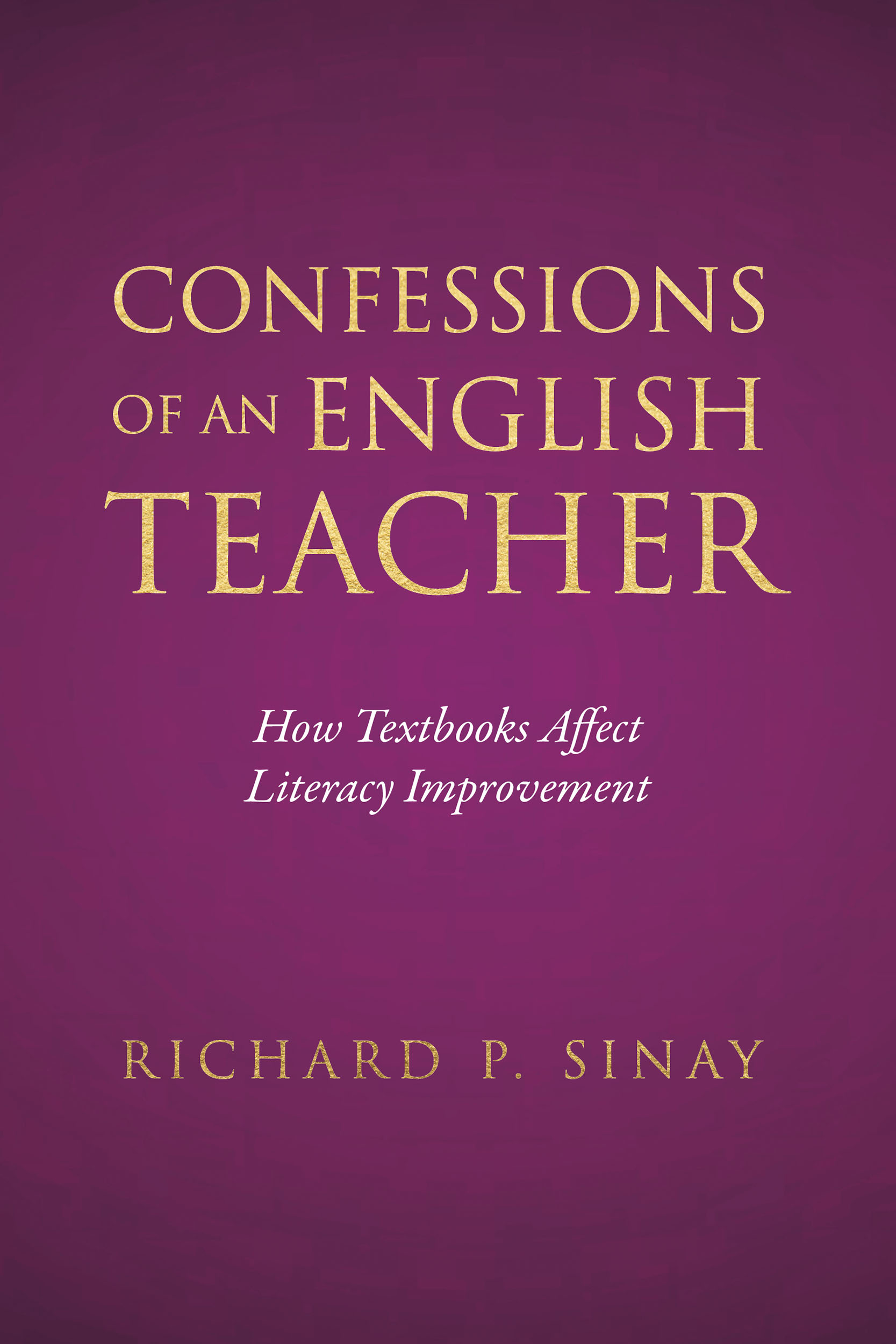
Confessions of an English Teacher Book 3
by Richard Sinay
Listen to this review
Confessions of an English Teacher: How Textbooks Affect Literacy Improvement and What to Do to Solve It advances a clear, consequential argument: high school English classes for average students should not be organized around literature anthologies that leave too little room for reading instruction, writing, and other literacy skills. Richard P. Sinay writes from a teacher’s perspective, combining criticism of the textbook system with proposals for a more tailored curriculum. The book’s practical urgency is its chief strength, though its broad claims are not always matched by equally substantial evidence.
Part I builds its case through a sequence of objections, from outdated or culturally unsuitable selections to linguistic difficulty and the limits textbooks place on teachers. Chapter 1’s account of a survey-based American literature curriculum gives the critique a concrete starting point: students move through historical units and canonical writers, while instruction in reading, writing, grammar, and usage may be pushed aside. The contents of later chapters show that Sinay regards this not as a narrow materials problem but as a structural one. In his view, a literature-heavy, one-size-fits-all curriculum can impede literacy rather than foster it.
The argument is most persuasive when it turns from general diagnosis to classroom practice. In Chapter 16, Sinay describes reading “The Legend of Sleepy Hollow” aloud and following students’ questions about Ichabod Crane and the Headless Horseman back into the story. He also recalls reading passages from The Scarlet Letter, using character voices to make Hawthorne’s language vivid. These anecdotes illustrate his conviction that reading should be pleasurable, social, and modeled by the teacher—not merely assigned. They give the book a personable quality and show how literary works might engage students when presented with attention to their experience.
Part II offers a constructive alternative: a custom-designed program that joins literature with explicit reading, writing, vocabulary, and comprehension instruction. The chapter sequence is usefully practical. It includes independent reading, reading alongside students, read-alouds, sustained silent reading, school-wide reading, and content-area literacy, as well as writing as a process and instruction in the MLA research paper. Sinay’s proposal that English teachers should also be reading teachers is a valuable corrective to curricula that assume exposure to texts will, by itself, produce stronger readers. His emphasis on helping students complete books and develop lasting reading habits is particularly compelling.
The book’s structure supports its central purpose: first identifying the problem, then laying out possible responses. Its plainspoken, direct style suits a teacher-facing work, and the author’s thirty-five years of experience in high school and college English and reading classrooms give his observations an evident practical basis. The emphasis on “average” students also addresses a group Sinay believes is underserved by programs designed for honors, AP, or IB students. That focus gives the book a defined audience and keeps its concern with accessibility in view.
That same forceful approach can narrow the discussion. The chapters’ recurring claims—that textbooks are culturally irrelevant, linguistically difficult, and damaging to literacy—are stated with conviction, but the supplied text offers limited systematic evidence for their scale or consequences. Sinay describes his experience and cites student responses, yet the listed works cited are sparse: three references, including a book on reading aloud and a study of what students should read. Readers looking for comparative research, detailed assessment data, or a fuller engagement with differing views on literature surveys may find the case under-supported. The book would be stronger if it more carefully distinguished among textbook designs, student populations, and ways teachers can adapt assigned materials.
There is also a productive tension in the proposed remedy. Sinay argues for greater teacher freedom and for custom curricula, but the practical demands of designing, selecting, and assessing such programs receive less attention in the material provided than the critique of textbooks does. Some recommendations, such as fifteen minutes of daily silent reading and school-wide reading periods, are appealingly concrete; others would benefit from more detail about implementation and how literacy growth should be measured. The arithmetic in Chapter 17 also merits checking: fifteen minutes across 165 days amounts to 2,475 minutes, rather than the stated 2,400. This small discrepancy does not undo the proposal, but it underscores the value of precision in a book that advocates measurement.
Sinay’s position is not that literature should disappear from English class; rather, he objects to letting the anthology dictate the course. That distinction matters. The book is most useful as a provocation to reconsider what an English curriculum owes students who need stronger reading and writing skills, and as a collection of classroom-tested ideas to adapt. It is less satisfying as a research-driven case against textbooks in general. English teachers, department leaders, and literacy advocates working with non-honors high school classes are the readers most likely to value its urgency and practical suggestions, especially if they approach its conclusions as a starting point for discussion rather than a final verdict.
Share-ready review images
Download square and vertical images for posts, stories, newsletters, and media kits.
For authors
Want a review page like this for your book?
Upload your manuscript, choose a review tier, and get a permanent public editorial review page you can share with readers.
Review My Book← Back to Reviews
