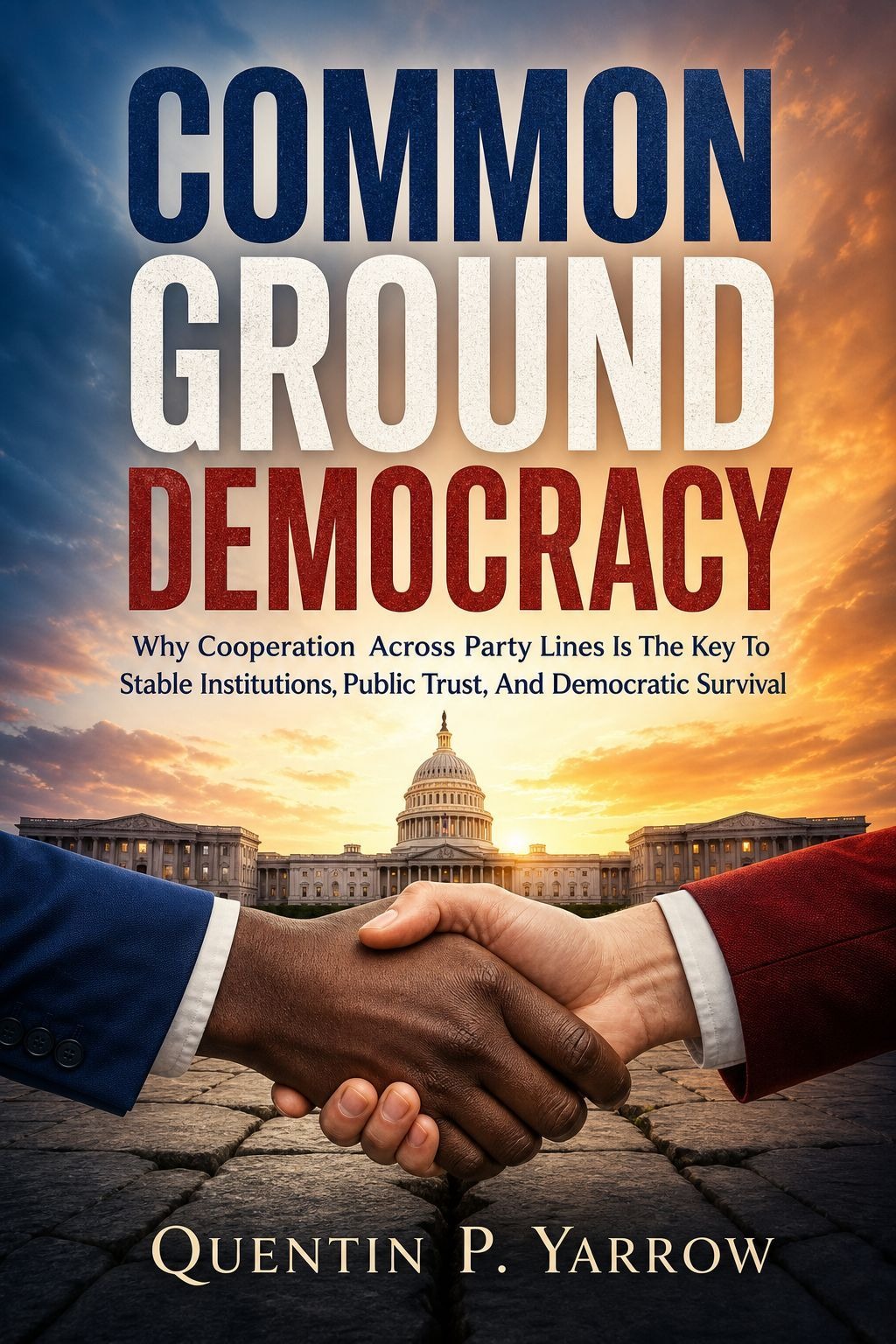
Buy this Book:
Political Science / General (POL000000)
Common Ground Democracy
by Quentin P. Yarrow
Listen to this review
Common Ground Democracy is a compactly argued civic brief rather than a narrative book, and it is most effective when read as a sustained meditation on the conditions that make self-government possible. Across its ten chapters, it makes a consistent case that democracy does not fail only through dramatic constitutional crisis; it erodes through habits of suspicion, performative conflict, and the slow replacement of civic identity with partisan identity. That thesis gives the book real coherence. Even when the prose turns repetitive, the argument remains clear: a democratic order survives not because citizens agree, but because they continue to treat disagreement as governable.
One of the book’s chief strengths is its conceptual discipline. The opening chapter, “Why Democracy Breaks Down When Cooperation Fails,” immediately defines the problem in structural terms: mistrust breeds escalation, escalation deepens mistrust, and institutions become judged by whether they can be captured or weaponized. That framework is carried forward with admirable consistency into later sections such as “Common ground as a method, not a slogan,” “Interpersonal trust versus institutional trust,” and “The incentives that reward outrage and punish nuance.” The recurring distinction between civic identity and partisan identity is especially useful. The book does not merely lament polarization; it explains how social belonging, moral certainty, and status-seeking can transform ordinary politics into a form of existential combat. That is a strong analytical move, because it shifts the discussion away from personalities and toward incentives, habits, and institutional design.
The prose itself is one of the book’s most notable assets. It is measured, declarative, and persistent in tone, often using balanced antitheses to make the argument memorable: compromise versus domination, restraint versus escalation, legitimacy versus humiliation. The writing is also careful about democratic vocabulary. Rather than treating “cooperation” as sentimental harmony, the text repeatedly defines it as a method for making conflict durable and procedurally legitimate. That nuance matters. In Chapter 2, for instance, common ground is not presented as agreement in advance on policy outcomes, but as a shared procedure that allows rivals to remain members of the same political community. Similarly, Chapter 9’s discussion of “Distinguishing principled compromise from surrender” gives the book moral texture by acknowledging that bargaining can be both necessary and dangerous, depending on whether it preserves equal citizenship and fair participation.
Another strength is the book’s attention to scale. It moves effectively from abstract principles to local examples of civic life: school boards, city councils, neighborhood associations, faith groups, nonprofits, and local officials. Chapter 3, “The Architecture of Trust,” is especially persuasive in this regard because it separates interpersonal trust from institutional trust and shows why the two cannot be substituted for one another. The discussion of procedural fairness is similarly convincing. The book understands that legitimacy is not sustained by outcomes alone, but by the visible experience of fairness in process. Its emphasis on predictable rules, public explanation, and consistent standards gives the argument practical grounding, particularly in sections that describe why citizens accept losses more readily when they believe the system still belongs to them.
There is also genuine value in the book’s treatment of civic habits. Chapter 7, “Listening as a civic skill,” and Chapter 6, “Why responsible leadership resists performative conflict,” are among the strongest chapters because they avoid vague moralizing and instead describe identifiable behaviors: withholding interruption, restating an opponent’s concern, resisting procedural tricks, honoring side agreements, and speaking in language that lowers hostility without denying disagreement. This emphasis on conduct gives the book a useful applied dimension. The appendix, with its “Tools for Cross-Party Cooperation,” reinforces that practicality and suggests the author intends the book to function as a guide as well as an argument.
Still, the book has limitations. Its most obvious weakness is repetition. Because the same core ideas recur in nearly every chapter—polarization hardens identity, trust enables cooperation, institutions need reciprocity, leadership should resist theatrical conflict—the structure can feel more cumulative than progressive. The chapters are lucid on their own terms, but the book often revisits the same claims in slightly altered language rather than developing a more surprising line of inquiry. Readers looking for a tightly paced political analysis or a more original theoretical intervention may find the argument somewhat familiar by the later chapters.
A related limitation is that the book’s normative emphasis on cooperation can, at times, flatten the harder realities of political conflict. It repeatedly urges reciprocity, restraint, and broad agreement, but because the supplied text is largely abstract, it offers limited evidence of where cooperation fails for reasons that are not simply moral or behavioral. Chapter 9 gestures toward bad-faith bargaining and the need to protect institutions from manipulation, which is an important safeguard, but the overall framework still tends to assume that better habits and better design will be enough. Readers seeking a more searching account of structural inequality, entrenched power, or conflicts in which common ground is genuinely unavailable may find the book incomplete.
The book’s strengths therefore lie less in novelty than in clarification. It is best when it turns familiar democratic ideals into concrete practices: listening, procedural fairness, durable coalitions, and institutional guardrails. Its tone is earnest, disciplined, and civic-minded, and that seriousness is appealing. Yet the same earnestness can also make the book feel doctrinal, especially since the argument is sustained more by reiteration than by surprising examples or case studies. That does not make it weak; it makes it specialized. This is a book for readers who want a principled, accessible defense of democratic cooperation and who are willing to engage an argument that is methodical rather than provocative.
Recommendation: Common Ground Democracy is best suited to readers interested in civic reform, democratic theory, public leadership, and practical anti-polarization arguments—especially teachers, local officials, community organizers, and engaged citizens looking for a clear framework for cooperation. It is a good fit for those who value clarity and civic purpose over novelty, but less compelling for readers seeking empirical depth, sharper conflict analysis, or a more original political thesis.
Share-ready review images
Download square and vertical images for posts, stories, newsletters, and media kits.
For authors
Want a review page like this for your book?
Upload your manuscript, choose a review tier, and get a permanent public editorial review page you can share with readers.
Review My Book← Back to Reviews
