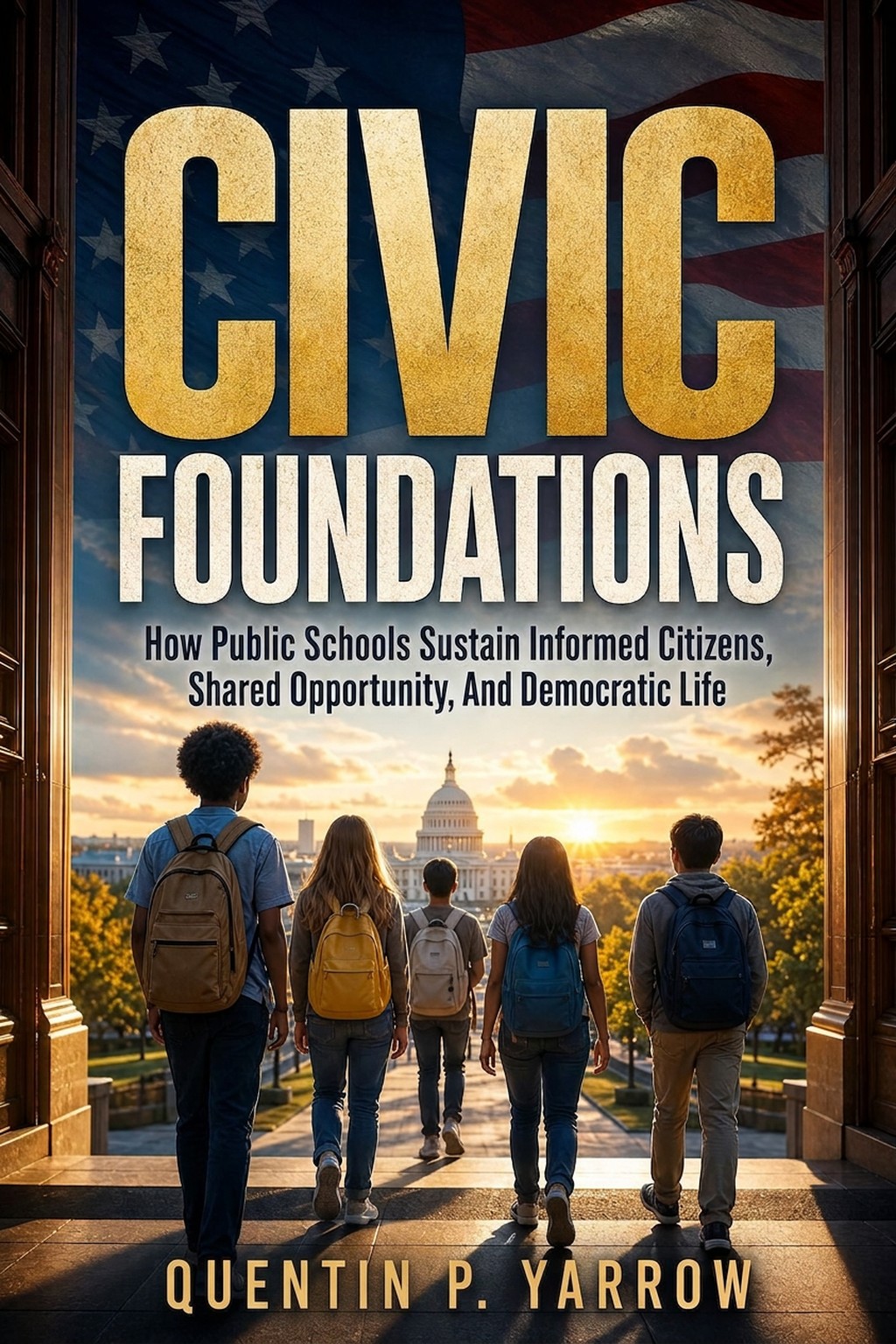
Buy this Book:
Education / Philosophy, Theory & Social Aspects (EDU040000)
Civic Foundations
by Quentin P. Yarrow
Listen to this review
Civic Foundations is a sustained argument for public schooling as one of democracy’s indispensable institutions, and its central virtue is that it never treats that claim as a slogan. Across nine chapters, the book returns to the same premise from different angles: schools are not merely places where children acquire skills, but civic spaces where a society practices coexistence, trust, and shared responsibility. That is an ambitious frame, and the manuscript largely earns it through steady, cumulative reasoning rather than rhetorical flourish.
What gives the book much of its force is its lucid, repetitive structure. Each chapter announces a civic concern and then develops it in plain, accessible prose: Chapter 1 on “Why Public Schools Matter to Democracy,” Chapter 2 on “The Civic Promise of Universal Education,” Chapter 4 on “The Hidden Curriculum of Belonging,” Chapter 6 on “Teachers as Civic Builders,” and Chapter 8 on “What Happens When Public Schools Are Weakened.” The progression is intelligently arranged. The book moves from broad democratic theory to classroom culture, from inequality and segregation to leadership and policy, and then toward practical action in the conclusion and appendix. That architecture helps the argument build rather than merely repeat itself.
The prose is strongest when it translates abstractions into everyday school life. In Chapter 1, for example, democracy is linked not to grand speeches but to ordinary classroom routines: waiting in lines, sharing teachers, arguing over assignments, listening before reacting, and learning to separate criticism from contempt. Chapter 3 extends this idea by treating critical thinking as a civic skill rooted in habits such as asking “How do we know that?” and “What else might be true?” Chapter 4’s discussion of belonging is similarly effective in showing how discipline, language, and expectations shape whether students feel “on display, misunderstood, or constantly one mistake away from humiliation.” These are not ornamental observations; they make the book’s civic philosophy concrete.
Another strength is the book’s refusal to reduce education to either sentiment or mechanics. It insists that belonging is not a soft add-on, that discipline is not only punishment, that teachers are not content-delivery systems, and that leadership is not charisma. In Chapter 6, the portrait of teachers as “intellectual and civic” workers is especially persuasive because it recognizes the constant interpretive labor of teaching: reading the room, making knowledge usable, and modeling how disagreement can be handled with attention rather than hostility. Likewise, Chapter 7’s emphasis on transparency, legibility, and community trust gives leadership a genuine civic dimension rather than a managerial one.
The book is at its best thematically when it connects educational inequality to democratic inequality. Chapter 5, on segregation and the erosion of shared life, argues with conviction that separated schools do more than distribute resources unequally; they train children into different expectations about whose lives count, what public institutions can be trusted, and whether the world is really shared. Chapter 8 sharpens that point by showing how austerity and instability produce not only material shortages but a climate of exhaustion, cynicism, and lowered expectations. In this respect, the book’s political argument is coherent and serious: public schools matter because they help create the habits, capacities, and trust that democracy requires to remain more than a formality.
Still, the book’s strengths are also tied to its limitations. Its prose is clear to the point of being highly controlled, and sometimes that control produces a sameness of cadence across chapters. The argument is compelling, but it is often made in the same reflective register, with few risks in voice, image, or narrative texture. Readers looking for a more varied literary style, sharper tension, or a more distinctive argumentative personality may find the book somewhat level in tone. The repeated use of formulations such as “that matters because” and “there is also” contributes to the sense of a carefully reasoned essay collection, but it can also make the prose feel programmed toward emphasis rather than discovery.
There is also a deliberate narrowness in the method. The book is conceptually rich, but it remains almost entirely at the level of civic principle and school culture. It offers many insightful claims about what schools should do, but in the supplied text it does not move into sustained case studies, contrasting examples, or detailed evidence from specific schools, districts, or students. That absence is not a flaw in every context—this is clearly a philosophical and public-facing work rather than an empirical report—but it does mean that readers hoping for granular policy analysis or on-the-ground complexity may want more than the book provides here. Its arguments are persuasive as ideals, but less textured as lived social history.
Similarly, the book’s normative clarity is one of its assets, yet it occasionally leaves little room for ambiguity. It is strongest when diagnosing how public institutions can fail students through inequality, segregation, or neglect. It is somewhat less expansive when confronting possible tradeoffs within public schooling itself. For example, the chapter on universal education argues powerfully for access and shared obligation, but the supplied text does not deeply explore tensions around parental choice, local autonomy, or competing visions of public purpose beyond warning against market-like fragmentation. Readers who want a more contested, pluralistic debate may find the book somewhat one-directional, even if that direction is intellectually defensible.
The appendix and concluding emphasis on “practical questions” is a welcome feature because it prevents the book from ending as abstraction. It suggests use in school communities, policy discussions, and family conversations. That practical orientation fits the book’s democratic ethic well. Even so, the manuscript feels most complete as a manifesto of educational civic purpose, not as a full manual for implementation. It is strongest in diagnosis, framing, and moral argument.
Recommendation: Civic Foundations will be most valuable to readers interested in education policy, democratic theory, school leadership, teacher advocacy, and the civic role of public institutions. It is especially well suited to educators, administrators, school board members, and general readers who want a clear, principled case for public schooling as a democratic good. Readers seeking vivid storytelling, extensive case evidence, or a more contested policy debate may find it less satisfying.
Share-ready review images
Download square and vertical images for posts, stories, newsletters, and media kits.
For authors
Want a review page like this for your book?
Upload your manuscript, choose a review tier, and get a permanent public editorial review page you can share with readers.
Review My Book← Back to Reviews
