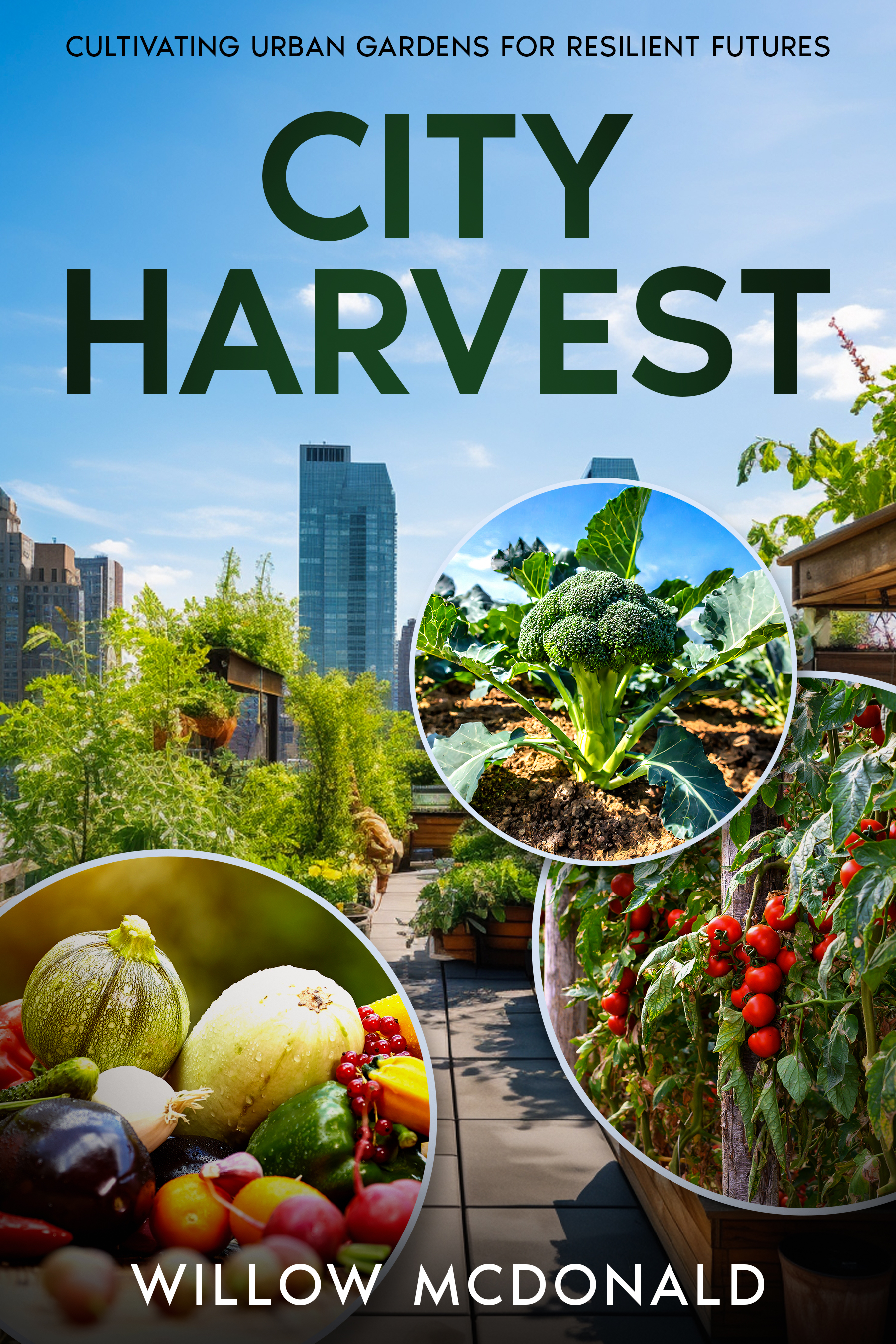
Buy this Book:
GARDENING / Urban & Community (GAR028000)
City Harvest
by Willow McDonald
Listen to this review
City Harvest presents itself as a practical guide to urban agriculture, but its deeper ambition is civic: it wants to persuade readers that growing food in cities can also grow resilience, equity, and community. Across twelve chapters, the book returns persistently to that thesis, whether discussing rooftop gardens, Community-Supported Agriculture, food deserts, policy reform, or the educational value of school garden programs. The result is less a narrowly technical manual than an advocacy text with instructional elements, written for readers who are curious about the broader social meaning of urban farming.
Its strongest quality is clarity of purpose. The book never loses sight of the central argument that urban agriculture is not merely decorative or recreational, but intertwined with food security, climate adaptation, and neighborhood cohesion. Chapter 1, “The Rise of Urban Agriculture,” establishes this framework effectively by connecting rooftop gardens, vertical farms, and community plots to broader concerns such as food deserts and urban self-reliance. Chapter 2 extends that logic into the social realm, framing urban gardens as “community hubs” where neighbors share skills, cultural traditions, and a sense of mutual care. That repeated emphasis on interdependence gives the book a coherent moral center.
The book is also successful in breadth. Rather than limiting itself to one scale of practice, it moves from the intimate and practical, as in Chapter 10’s “Site Selection and Preparation,” to the institutional and policy-oriented, as in Chapter 7’s discussion of zoning laws and advocacy. Chapter 3’s treatment of rooftop gardens, vertical farming, and CSA models gives the text some welcome specificity. Likewise, Chapter 8 makes an effort to show that urban agriculture can generate employment and business opportunities, naming roles such as nursery managers, horticulturalists, urban planners, and technologists. These sections broaden the book beyond idealism and suggest that the subject has real economic and logistical dimensions.
The text’s most persuasive passages are those that connect form and function. A rooftop garden is not presented only as a symbolic “green oasis,” but as a way to reduce heat, absorb stormwater, and shorten supply chains. In Chapter 6, the health argument is similarly practical: access to fresh produce is linked to improved nutrition and lower disease risk, while Chapter 6’s second section on climate change highlights water savings in vertical farming and insulation benefits from rooftop gardens. The book is strongest when it ties a single intervention to multiple outcomes, showing how urban agriculture can operate simultaneously as environmental infrastructure, public health strategy, and social practice.
That said, the book’s limitations are substantial, and they matter. Its prose is consistently energetic, but it often leans on abstraction rather than evidence or narrative development. Many chapters repeat the same handful of claims—resilience, sustainability, biodiversity, community, equity—without building much argumentative tension or offering detailed case studies. The table of contents promises “case studies of successful designs,” yet the supplied text does not deliver vivid examples with names, dates, or concrete outcomes. As a result, the book can feel more like an extended position paper than a fully realized guide.
The style, while accessible, is also highly generalized. Sentences often pile up adjectives and metaphors—“green threads,” “urban lungs,” “lush oases,” “seed of change”—that create enthusiasm but sometimes flatten distinctions between different contexts. That rhetorical consistency gives the book a polished promotional tone at times, even when it is clearly aiming for educational seriousness. Readers looking for a skeptical, data-driven examination of what urban agriculture can and cannot accomplish may find the book too affirmative and insufficiently self-critical.
Structural repetition is another weakness. Because each chapter follows a similar pattern—introducing the value of urban agriculture, naming common benefits, then restating the need for collaboration—the reading experience can become cyclical. Chapters 4, 5, 6, and 7 in particular circle around equity, planning, health, and policy in ways that reinforce the thesis but do not always deepen it. The glossary at the end is a useful addition, but it also underscores the book’s didactic orientation: this is a text eager to define terms and encourage participation, not one that develops complex case studies or contested debates.
At the same time, those limits are partly a function of the book’s intended audience. City Harvest is likely best suited to community gardeners, beginning urban farmers, teachers, neighborhood organizers, students, and policy-minded general readers who want an optimistic overview of the field. Chapter 9’s focus on schools and community centers, and Chapter 10’s practical advice on sun exposure, water access, and soil testing, make the book especially useful as an introductory resource. It may also appeal to readers who want to understand urban agriculture as a social movement rather than a purely horticultural practice.
As an editorial project, City Harvest has admirable coherence and genuine civic energy. It argues, convincingly if somewhat repetitively, that food production in cities can become a means of environmental stewardship and social repair. But its broad claims, limited specificity, and occasional reliance on uplift over analysis keep it from being a definitive treatment. Recommended for readers seeking an accessible, advocacy-oriented introduction to urban agriculture and its community applications; less suitable for those looking for a deeply reported, critically balanced, or technically specialized study.
Share-ready review images
Download square and vertical images for posts, stories, newsletters, and media kits.
For authors
Want a review page like this for your book?
Upload your manuscript, choose a review tier, and get a permanent public editorial review page you can share with readers.
Review My Book← Back to Reviews
