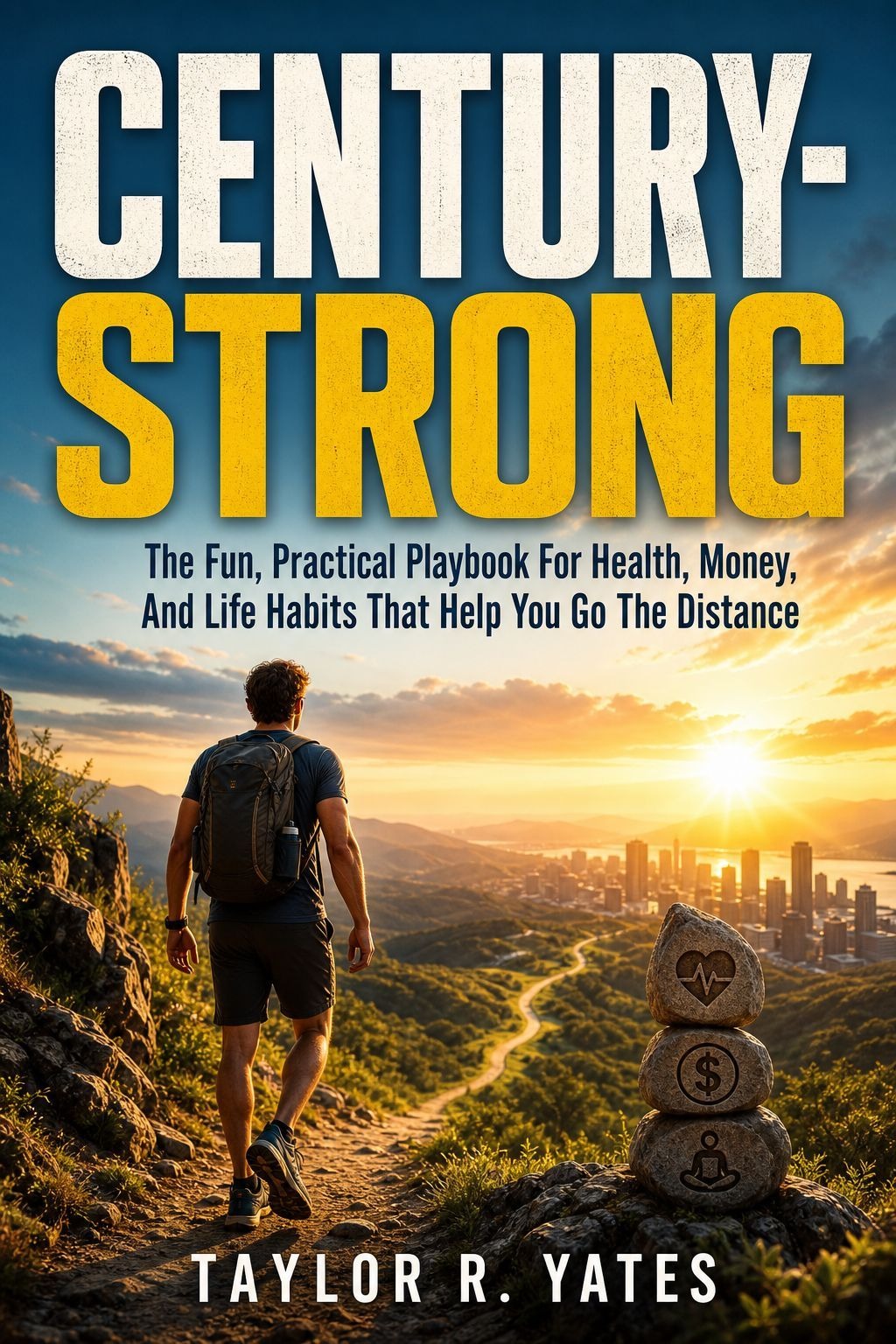
Buy this Book:
Self-help / Compulsive Behavior / General (SEL041000)
Century-Strong
by Taylor R. Yates
Listen to this review
Century-Strong is a practical, unpretentious guide to the maintenance of a long life, and its strongest quality is also its clearest literary identity: it treats durability as a more interesting virtue than optimization. Across chapters on mindset, baseline-setting, food, movement, sleep, stress, money, relationships, preventive care, and environment, the book argues—persistently and with considerable rhetorical discipline—that the real engine of healthspan is not dramatic self-reinvention but repeatable, low-friction habits. That premise is not novel in the abstract, but the manuscript gives it a coherent shape by linking domains that are often siloed. A skipped workout, a sloppy week of sleep, financial drift, and social isolation are all framed as part of the same slow accumulation of risk. The result is a holistic self-help text with a clear throughline: future wellbeing is built by ordinary systems, not heroic moods.
The prose is lively, direct, and often sharply observant. The writer has a gift for turning familiar advice into memorable language without losing clarity. Phrases such as “snack food and wishful thinking,” “the bank account both tend to reward pressure relief before they reward fine-tuning,” and “the expensive sentence in personal finance” give the book personality while keeping it grounded in practical instruction. The tone is consistently humane. Instead of shaming readers for inconsistency, the book normalizes the realities of tiredness, overcommitment, and imperfect weeks. That emotional intelligence matters, especially in a genre where readers are often bruised by prior attempts at self-improvement. The book’s insistence that a “messy week like a normal human” is not failure helps make the argument feel usable rather than punitive.
Structurally, the book is one of its best assets. The chapter sequence is logical and cumulative: it begins with mindset and baseline assessment, moves through food, exercise, sleep, stress, money, and relationships, then closes with preventive care and environmental design. This progression makes sense because it moves from internal framing to external systems. Chapter 1’s focus on rejecting all-or-nothing thinking establishes the philosophical foundation; Chapter 2’s “quick-and-dirty life inventory” then translates that mindset into measurement. Later chapters continue the same pattern: Chapter 3 reduces nutrition to a durable plate template; Chapter 4 identifies the “minimum effective dose” of movement; Chapter 5 reframes sleep as a system-level necessity; Chapter 7 treats money as autopilot infrastructure. The appendices promised in the table of contents—starter plans, review checklists, and templates—also suggest a useful bridge from concept to implementation, which is a major strength for a book of this kind.
What gives the book additional weight is its repeated effort to integrate longevity with real-world constraints. It does not assume readers have unlimited time, money, or emotional bandwidth. The chapters on food, movement, and stress repeatedly make room for backup versions, default orders, small wins, and “sane intensity” rather than maximalist performance. In Chapter 8, the social dimension of longevity is handled with particular care: connection is presented not as a sentimental bonus but as infrastructure, something that shapes behavior and resilience over time. Likewise, Chapter 9’s preventive-care section avoids both neglect and paranoia by distinguishing useful health monitoring from “the health detective lifestyle.” This capacity to hold opposites—benefit without obsession, discipline without perfectionism—is arguably the book’s central intellectual move.
The book’s evidence-based posture is another strength, though it is not without friction. The citations, mostly bracketed references to aging, sleep, diet, movement, and social support research, lend the text a serious and contemporary feel. The recurring claims about compounding, resilience, and risk accumulation are consistently aligned with the book’s practical message. At the same time, the integration of citations is somewhat uneven in presentation. Because the supplied text offers chapters alongside a long reference list rather than footnoted argumentation, the scholarly scaffolding can feel appended rather than organically woven into the prose. Readers looking for a more academic treatment of longevity science may find the evidence signposting reassuring but not fully satisfying.
The book’s limitations are tied to its chosen mode. Its strengths in accessibility and momentum are also its chief constraint: this is a broad, general-audience manual, not a deeply specialized one. Readers hoping for detailed clinical guidance, advanced financial planning, nuanced psychiatric discussion, or rigorous nutritional analysis will likely find the treatment intentionally simplified. The advice is useful precisely because it is general—“protein, fiber, and the boring foods that do the heavy lifting,” “a paycheck plan you can run on autopilot,” “a life hard to break”—but that same broadness means the book sometimes trades precision for reach. In Chapter 3, for instance, the plate-template approach is sensible, but readers with highly specific medical, dietary, or athletic needs may need more tailored instruction than the book aims to provide. Similarly, Chapter 7’s money guidance is solidly practical but may feel elementary to readers already operating from a detailed financial system.
There is also a stylistic repetition that, while thematically intentional, may limit the book’s dramatic range. The constant emphasis on boring basics, durability, and repeatable patterns creates impressive coherence, but it can also flatten the emotional texture of the reading experience. The book is at its best when that repetition sharpens the argument; it is less effective when the same conceptual language appears across many chapters with only minor variation. Readers who prefer more narrative movement, case studies, or personal storytelling may find the format somewhat instructional and abstract. The table of contents suggests a robust practical workbook, but the excerpted chapters read more like a polished manifesto than a lived-in memoir of change.
Still, those are limitations of fit, not failures of purpose. Century-Strong is most persuasive when read as a steadying manual for adults who want to build a life that will still hold together when circumstances get messy. It is especially well suited to readers who are starting from inconsistency, burnout, or scattered habits and want a coherent framework for getting back to basics without self-contempt. It should also appeal to readers who like practical prose, moderate evidence use, and a holistic view of health that includes food, movement, sleep, stress, money, relationships, and medical maintenance. I would recommend it most strongly to general readers seeking a durable, non-dogmatic roadmap for better long-term living; readers wanting highly technical expertise or deeply personal narrative may find it less compelling.
Share-ready review images
Download square and vertical images for posts, stories, newsletters, and media kits.

For authors
Want a review page like this for your book?
Upload your manuscript, choose a review tier, and get a permanent public editorial review page you can share with readers.
Review My Book← Back to Reviews
