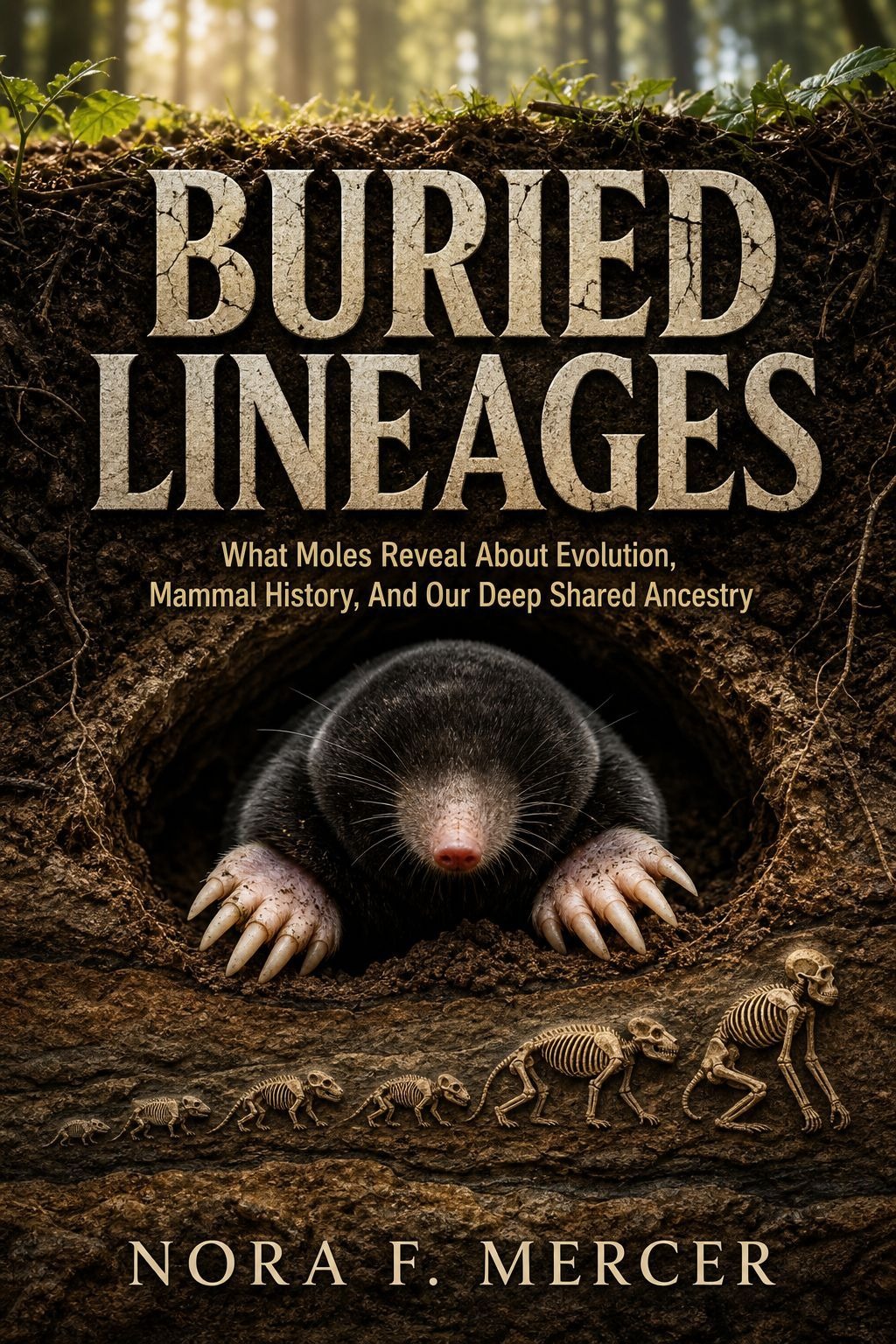
Buy this Book:
Nature / Animals / Mammals (NAT019000)
Buried Lineages
by Nora F. Mercer
Listen to this review
Buried Lineages is an admirably focused work of natural history and evolutionary explanation, one that takes a creature many readers dismiss as a garden nuisance and uses it to illuminate larger questions about adaptation, constraint, and the shape of mammalian life. Its central strength is methodological as much as thematic: rather than treating “the mole” as a single picturesque oddity, the book repeatedly returns to variation within and among lineages, showing how true moles, shrew moles, desmans, and other subterranean mammals solve overlapping problems in different ways. That comparative frame gives the book genuine intellectual traction. It is not simply describing an animal; it is using that animal to ask how bodies become specialized, what evolution can and cannot redesign, and why similar habitats so often produce similar forms.
The writing is at its best when it slows down to make the mechanics of underground life legible. Chapter 3, “Built for Digging: The Mole Body Plan,” offers some of the clearest prose in the manuscript, especially in its account of the forelimb as a tool for “turning muscle into displacement.” The distinction between running and digging is rendered with precision: a mole does not move like a cursorial mammal, sweeping its limbs through open space, but wedges claws into compacted earth and pushes against resistance in short, forceful strokes. Likewise, Chapter 4’s treatment of tactile sensing, whiskers, and snouts makes the reader feel the tunnel as a sensory environment rather than merely an empty corridor. The same is true in the discussion of the star-nosed mole, whose “sensory constellation” is presented not as a curiosity but as an evolutionary answer to a specific bottleneck in prey detection. These passages are persuasive because they connect anatomy, behavior, and ecological circumstance without losing the reader in jargon.
Another major strength is the book’s insistence on trade-offs. Again and again, Buried Lineages avoids the flattening language of perfection. Reduced eyes are not described as defects but as costs and compromises; powerful forelimbs are acknowledged to be less useful for rapid surface movement; tunnel systems are shown to be both shelter and constraint. That balance gives the argument credibility. Chapter 5, on tunnels as homes, traps, and hunting grounds, is particularly effective in showing how underground space can be simultaneously productive and limiting: a mole’s passages create access to prey but also bind the animal to the routes it has already invested in. The result is a book that understands adaptation as negotiation rather than triumph.
Thematic range is also one of the book’s assets. It moves from physiology to ecology to deep time and, by Chapter 10, to conservation and coexistence without abruptly changing register. The late chapters are especially valuable because they remind the reader that evolutionary specialization is not just an abstract puzzle but a lived ecological relationship. The section on why moles are often disliked is observant and humane: it notes how easily visible ridges and mounds are mistaken for damage, how hidden animals are judged by traces rather than lives, and how human preferences for manicured surfaces can obscure the ecological work moles perform. This is a thoughtful ending to the book’s scientific argument, since it reconnects evolutionary biology to public perception and habitat change.
The book’s structure is also clear and cumulative. The chapter sequence progresses logically from underground life in general, to mole diversity, to body plan, sensory systems, behavior, diet, convergence, fossils, ancestry, and finally conservation. The Table of Contents suggests a comprehensive guide, and the chapters delivered here largely fulfill that promise. The inclusion of an appendix with a field guide, glossary, lineage overview, and misconceptions section further reinforces the book’s usefulness as a reference for interested general readers. In that sense, the manuscript is not only informative but well organized for sustained reading and later consultation.
Still, the book’s strengths come with a few limitations. At the level of style, it is sometimes so committed to explanatory clarity that the prose can become repetitive. Many chapters reiterate the same core insight—that evolution reworks inherited parts under environmental pressure—at some length. That repetition is thematically consistent, but it can also make the middle of the book feel less varied than it might. The same caution appears in the discussion of convergence and constraint, where several chapters revisit similar examples and conceptual distinctions. Readers who want a tighter, more compressed argument may find the book occasionally expansive to a fault.
There is also a certain abstraction in the treatment of evidence. The citations suggest a serious research basis, but within the supplied text, the references function more as support for general claims than as invitations into specific studies or debates. That is not a flaw for a broad natural-history audience, but it means the book is less animated by field detail than by synthesis. Some readers may wish for more concrete observational scenes, more species-specific case studies, or more vivid accounts of how particular moles behave in particular environments. As written, the book privileges conceptual explanation over narrative immediacy.
Finally, while the book’s broad evolutionary framing is one of its chief virtues, it may also be a weaker fit for readers seeking a strictly zoological handbook or a heavily technical monograph. The text is clearly written for informed general readers and students of evolution rather than specialists looking for dense taxonomic argumentation or exhaustive species-by-species documentation. Its ambition is interpretive: to show what moles reveal about mammalian evolution, not to catalog every known fact about mole biology.
Recommendation: Buried Lineages is best suited to readers who enjoy accessible evolutionary science, comparative anatomy, and carefully argued natural history, especially those interested in how specialized animals illuminate larger questions about mammal ancestry and adaptation. It will reward attentive general readers and students of biology most; readers wanting a brisk, data-heavy field guide or a more intimate, story-driven wildlife book may find it less compelling.
Share-ready review images
Download square and vertical images for posts, stories, newsletters, and media kits.
For authors
Want a review page like this for your book?
Upload your manuscript, choose a review tier, and get a permanent public editorial review page you can share with readers.
Review My Book← Back to Reviews
