Buy this Book:
House & Home / General (HOM000000)
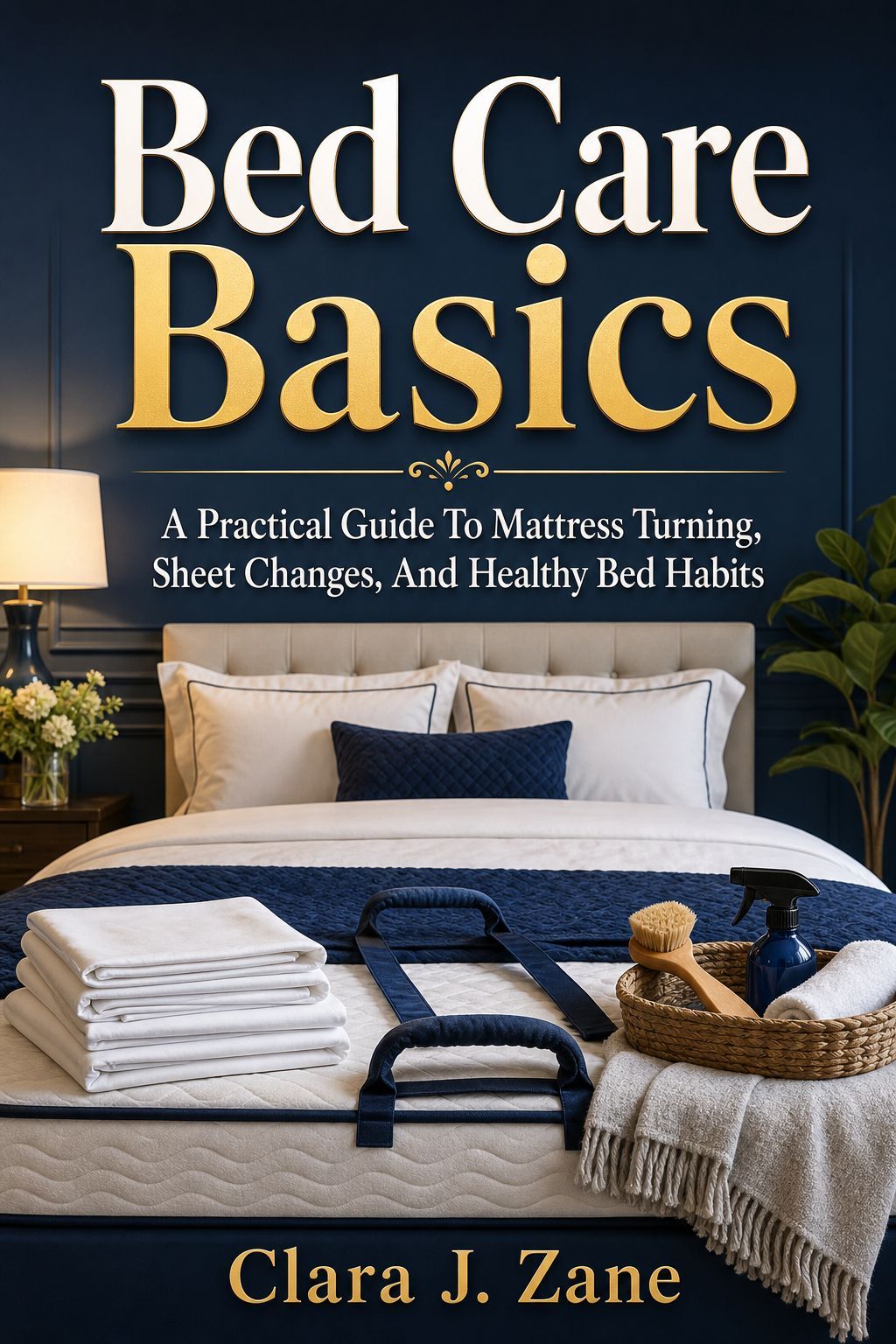
Bed Care Basics
by Clara J. Zane
Listen to this review
Bed Care Basics is, on the evidence of the supplied text, a practical manual that takes an everyday subject and treats it with unusual seriousness. Its central claim is simple but persuasively sustained across the chapters: a bed is not a static object but a system of materials that respond to pressure, moisture, friction, and habit. That premise gives the book coherence. Rather than scattering advice in a loose checklist, it builds from first principles in Chapter 1, moves into routine-building in Chapter 2, and then narrows into specific components such as mattresses, linens, pillows, and room-specific standards.
One of the book’s strongest qualities is the clarity of its prose. The writing is direct, methodical, and almost studiously unglamorous, which suits the subject. Sentences such as the discussion of how “body weight,” “movement,” “moisture,” and “soiling” wear down a bed are organized in a way that makes maintenance feel legible rather than mysterious. The author repeatedly translates abstract upkeep into observable signs: a sheet thinning at the corners, a pillow flattening, a mattress developing a “hammock” feel, a protector bunching out of place, or odors lingering after laundering. That attention to visible and tactile evidence gives the book authority. It does not merely tell the reader to care for the bed; it shows what carelessness looks like in material terms.
The structure is also a notable strength. Chapter 1 establishes why bed care matters not only for hygiene but for comfort and social perception, particularly in homes and hospitality settings. Chapter 2 then turns that rationale into a “simple framework” built around daily, weekly, seasonal, and setting-specific routines. Later chapters extend the framework into more specialized domains: Chapter 3 explains the difference between turning, rotating, and leaving a mattress in place; Chapter 4 deals with laundering and storage; Chapter 5 defines what belongs in bed and what does not; Chapter 6 covers pillows, blankets, duvets, and arrangement; and Chapter 7 adapts the advice to private homes, shared housing, caregiving, and guest accommodations. The result is a book that feels designed for practical use rather than casual browsing. Its architecture is cumulative and easy to follow.
Thematic range is broader than the title might initially suggest. The book is certainly about cleanliness, but it is also about habit formation, maintaining dignity, and preventing neglect through routine. Chapter 1’s discussion of what a well-maintained bed “communicates” in a home or hospitality setting introduces a subtle social dimension: the bed becomes a sign of attentiveness, professionalism, and respect for other people’s comfort. That idea reappears in the caregiving material, where the text rightly emphasizes that a clean, dry, correctly fitted bed can help preserve privacy and dignity. These passages elevate the book beyond housekeeping advice and give it a humane undertone.
Its usefulness also depends on its specificity. The text is strongest when it names concrete risks and responses: allowing the bed to “breathe” after waking, not storing bedding in sealed plastic for long periods, using trays and lidded containers if food must be allowed in bed, or checking whether a mattress has visible top and bottom surfaces before attempting to rotate or flip it. The advice is grounded in ordinary conditions rather than idealized ones. The chapters on tailored schedules are especially effective because they acknowledge variation among homes, children, shared spaces, caregivers, and hospitality settings instead of prescribing a single universal routine. That sensitivity to context is a genuine strength.
At the same time, the book’s major limitation is also apparent from the text: its scope is almost entirely instrumental. It is a manual of prevention and maintenance, not a reflective or imaginative work. Readers looking for narrative complexity, psychological depth, or a more richly stylized prose voice will not find that here. The tone is steady, repetitive, and heavily explanatory. That repetition is useful for retention, but it can also make sections feel overly similar in rhythm and emphasis. The same admonitions about moisture, crumbs, odors, and clutter recur across chapters, sometimes with only slight variation. For a reference book, that redundancy is understandable; for a reader hoping for a more concise guide, it may feel elongated.
There are also places where the book’s comprehensiveness may outpace the needs of its audience. Chapter 7’s distinctions among private homes, renters, caregivers, and hospitality settings are practical, but some readers may find the level of granularity more detailed than they need, especially if they simply want a basic home routine. The text is careful, even cautious, about matters such as mattress handling, laundering, and food in bed, but that caution can make the book feel somewhat conservative in outlook. It prefers rules, boundaries, and regular inspection, which will appeal to readers who like structure but may feel restrictive to those who want a looser approach to household care.
Still, within its chosen purpose, the book is disciplined and well organized. The mention of an appendix with checklists, reminder charts, a laundry quick guide, and bed rules suggests a useful back-end practical function, and the table of contents reinforces the sense that this is intended as a working handbook. If the full text continues in the same mode as the supplied chapters, it should be especially valuable for people who need bed care to be consistent rather than intuitive: caregivers, hosts, property managers, parents, and anyone trying to establish a maintainable home routine.
Recommendation: Bed Care Basics is best suited to practical readers who want a structured, nontechnical guide to keeping beds cleaner, longer-lasting, and easier to manage across different settings. It should be especially useful for households, caregivers, and hospitality workers. Readers seeking literary flair, broader domestic philosophy, or a more concise quick-reference booklet may find it less compelling.
Share-ready review images
Download square and vertical images for posts, stories, newsletters, and media kits.


For authors
Want a review page like this for your book?
Upload your manuscript, choose a review tier, and get a permanent public editorial review page you can share with readers.
Review My Book← Back to Reviews
