Buy this Book:
Cooking / Health & Healing / Diabetic & Sugar-Free (CKB025000)
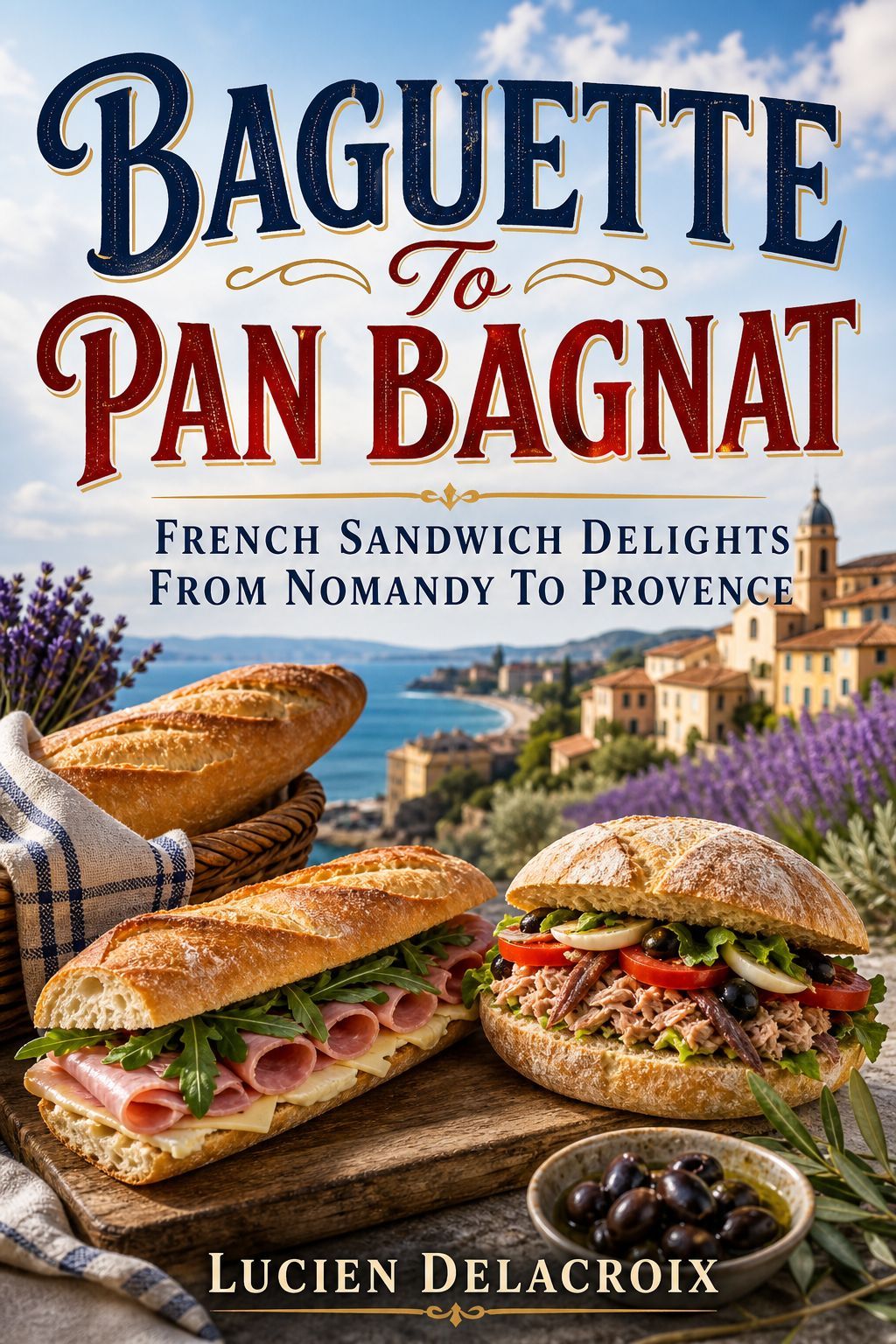
Baguette to Pan Bagnat
by Lucien Delacroix
Listen to this review
Baguette to Pan Bagnat is less a conventional cookbook than a guided tour through the cultural symbolism of French sandwiches, and it is at its strongest when it treats the sandwich as a vessel for regional identity. The book’s central premise is appealingly specific: from the opening chapter’s meditation on why sandwiches are universally beloved to the final chapters on the Jambon Beurre, Pan Bagnat, and Croque Madame, it argues that bread-and-filling combinations can carry history, geography, and taste in equal measure. That ambition gives the project real shape. Rather than offering a bare collection of recipes, the book repeatedly tries to connect culinary practice to larger ideas such as terroir, sustainability, migration, and the social ritual of eating.
The most effective passages are those that balance description with sensory clarity. The chapter on the Croque Monsieur, for example, does more than name ingredients; it explains the role of béchamel, Gruyère, and sturdy bread in creating the sandwich’s signature richness. The same is true of the Jambon Beurre, whose appeal is framed through restraint: thinly sliced ham, room-temperature butter, and a crisp baguette. In these moments, the prose understands that culinary writing succeeds when it isolates the precise mechanics of pleasure. The reader can easily imagine the sandwich’s texture and balance. The book is also good at recognizing that French sandwich culture is not singular but regional. Chapters on Auvergne-Rhône-Alpes, Brittany, Burgundy-Franche-Comté, Centre-Val de Loire, Corsica, Grand-Est, Île-de-France, and Provence-Alpes-Côte d’Azur give the volume a federated structure, allowing each region to emerge through signature preparations such as the Galette-Saucisse, Rillettes de Tours, Comté Cheese and Pâté Sandwich, and Corsican Steak Sandwich.
This regional emphasis is one of the book’s best ideas. It lets the author move beyond clichés about French cuisine as merely elegant or ornate and instead present a more grounded picture of food as local practice. The chapters often tie ingredients to landscape and history: Brittany’s buckwheat crepes and sausage street food, Provence’s olive oil and tomatoes, Corsica’s herbs and charcuterie, or Burgundy’s cheese, pâté, and wine pairing traditions. When the book is operating in this mode, it has an informative, almost pedagogical rhythm. The inclusion of wine-pairing sections further reinforces the sense that a sandwich can belong to a broader meal culture, not just a quick lunch format.
There is also an earnestness to the writing that makes the book approachable. It clearly wants to welcome home cooks, not intimidate them. Recipe sections are usually framed as invitations rather than technical trials, and the repeated suggestions for substitutions or variations—mustard in the Croque Monsieur, vegetarian versions of pan bagnat, plant-based fillings, and fusion ideas like the Korean BBQ sandwich—show a desire to adapt tradition to contemporary tastes. That flexibility is a real strength. It prevents the book from becoming a museum exhibit and instead positions French sandwich-making as living, revisable practice.
Still, the book has substantial limitations. The most obvious is repetition. Much of the volume reiterates the same claims in slightly different language: French cuisine values terroir; sandwiches reflect regional identity; quality ingredients matter; presentation matters; simplicity is elegant. Because these ideas recur so often, the prose can feel circular rather than cumulative. A shorter treatment would likely have been sharper. The book also suffers from an uneven relationship to specificity. It promises regional grounding, but many of the chapters rely on generalized praise—“rich,” “rustic,” “elegant,” “sophisticated,” “balanced”—without always developing those qualities into new insight. In a work so focused on local culinary culture, the abundance of broad adjectives can flatten distinctions between regions.
There are also noticeable editorial and structural issues. Some chapter material appears duplicated or reintroduced in outline form, and the table of contents-like sections at the end repeat the book’s organization rather than refining it. Several headings are echoed with slight variations, suggesting either compilation from multiple drafts or a lack of final consolidation. The most distracting flaw, however, is textual corruption and formatting instability: “Auvergne-Rhône-Alpes,” “Provence-Alpes-Côte d'Azur,” and other encoding issues interrupt the reading experience. These glitches matter because they undermine the polished, celebratory tone the book aims for. Likewise, some transitions feel abrupt, and the book’s broad thematic claims sometimes outpace the depth of its evidence. It is one thing to say that French cuisine has global influence; it is another to substantiate that idea beyond a list of familiar reference points such as Le Cordon Bleu or the Michelin Guide.
Readers looking for rigorous culinary history or detailed, test-kitchen recipe development may find the book too impressionistic. Its recipes, while appealing in concept, are often embedded in promotional-sounding prose and broad cultural commentary rather than precise technical guidance. Conversely, readers who enjoy food writing as cultural overview—especially those interested in the symbolism of French regional dishes and the pleasures of accessible, adaptable sandwich recipes—will likely find much to appreciate. Recommended for casual cooks, Francophiles, and readers who want an enthusiastic regional survey of French sandwiches; less suitable for those seeking a tightly edited, deeply researched culinary manual.
Share-ready review images
Download square and vertical images for posts, stories, newsletters, and media kits.
For authors
Want a review page like this for your book?
Upload your manuscript, choose a review tier, and get a permanent public editorial review page you can share with readers.
Review My Book← Back to Reviews
