Alternative Medicine
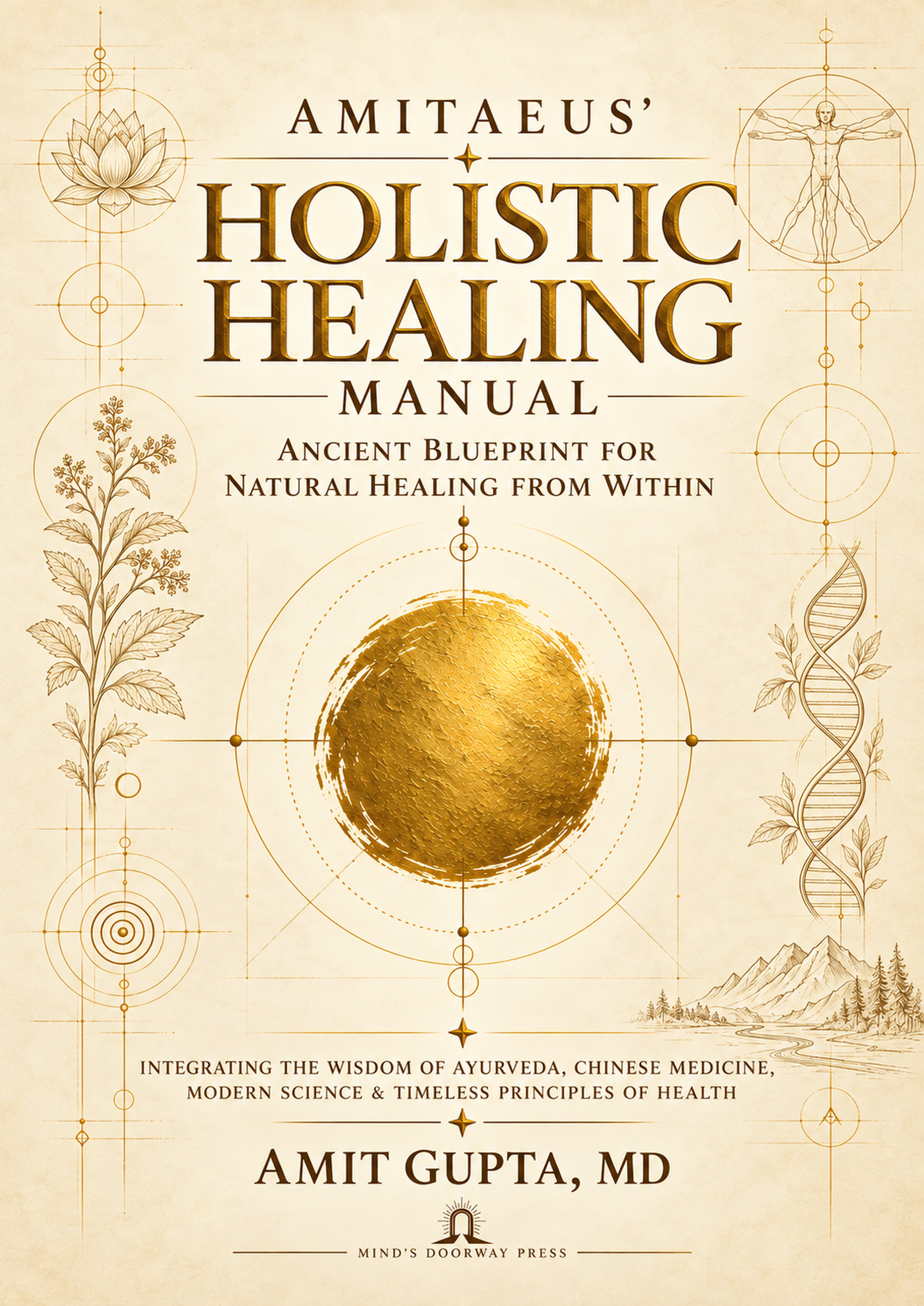
Amitaeus' Holistic Healing Manual: Ancient Blueprint for Natural Healing from Within
by Amit Gupta, MD
Listen to this review
Amitaeus’ Holistic Healing Manual is an ambitious attempt to turn Ayurvedic ideas into a comprehensive system for understanding health. In the chapters represented here, Amit Gupta organizes the body and mind around three forces—Neuro, Thermo, and Tropho—and uses their balance to explain constitution, symptoms, dietary response, emotional patterns, and spiritual development. The scope is striking: the book moves from digestion and food preparation to mental health, yoga, and self-inquiry. Its central appeal is the promise of coherence: scattered experiences might be read not as unrelated problems but as connected expressions of a larger pattern.
The system is most persuasive as a framework for attentive self-observation. Chapters 13–17 build a sequence from constitutional baseline to signs, bodily outputs, disease progression, and overlapping patterns. The example of Jen, who recognizes her irregular digestion, early waking, dry skin, and racing thoughts as expressions of a Neuro pattern, shows the emotional force of this approach. Rather than offering another isolated remedy for each complaint, the book gives her a unifying interpretation. The “Awareday” practice—observing signals, interpreting them, making a small adjustment, and observing again—likewise provides a concrete routine for readers who want to notice how sleep, meals, and stress affect them.
Gupta’s prose is direct, explanatory, and often vivid. He favors practical analogies: the three forces become limbs of a tree, while digestion and mental processing are compared to baking bread. These images make an elaborate vocabulary easier to follow. The chapter on six tastes is especially accessible, presenting taste as a quick way to think about food’s effects and distinguishing an ingredient’s qualities from manufactured flavor. The book also makes useful structural distinctions within its own model, such as separating obstructive residue from degraded material used to build tissue, and emphasizing that different patterns call for different interventions. Its recurring insistence on consistency rather than perfection is a humane counterweight to the wellness industry’s appetite for short, punishing protocols.
The structure is clearly designed to accumulate. Early chapters establish forces and constitution; later chapters apply them through food, rhythm, movement, breathwork, and external therapies; still later sections extend the framework into mental and spiritual life. Cross-references and recurring case examples give the manual continuity, while “Modern Reflection” sections signal an effort to engage contemporary research. The result may be useful to readers who enjoy comprehensive systems and are willing to learn a specialized vocabulary. Yet the breadth also becomes a liability: concepts introduced as metaphors or traditional principles are sometimes presented with the confidence of established physiology, without consistently marking where one ends and the other begins.
That distinction matters because the book makes consequential health claims. It suggests that many chronic conditions begin in functional imbalances that conventional tests miss, characterizes screening as unable to detect the proposed underlying state, and describes anxiety and other mental disorders as outputs of force imbalance. It also makes specific claims about fasting and overnight “self-cleaning,” food combinations, oils, carbohydrate restriction, reproductive tissue, immunity, and the effects of particular foods or practices. References are supplied in places, and some discussions—such as the summary of omega-3 trials—show engagement with research. But citation alone does not establish the larger model, and the excerpt does not consistently distinguish evidence for a narrow mechanism from evidence for the book’s broader conclusions. Some claims are framed as fact where readers would need clearer qualification, stronger substantiation, or an account of competing evidence.
The treatment of conventional medicine is similarly uneven. The manuscript acknowledges that medication and clinical care have legitimate roles, and says the model does not replace diagnosis. Those caveats are important. Still, passages arguing that symptom suppression can allow an underlying condition to worsen, or that correction rests primarily with the individual, risk encouraging readers to distrust appropriate treatment. The claim that roughly nine in ten burdens arise from lifestyle is particularly sweeping in the supplied material, as is the suggestion that mental disorders generally follow the same staged course as physical imbalance. Such statements require careful evidence and more explicit limits. A framework for reflection is not, by itself, a reliable method for diagnosing or treating disease; persistent or severe symptoms warrant qualified medical care.
The book’s later movement into consciousness, the Self, chakras, and spiritual discernment gives it a distinctive ambition, but also narrows its likely readership. Readers looking for a conventional, tightly evidence-graded health guide may find the blend of biomedical terminology, Ayurvedic concepts, and metaphysical claims difficult to evaluate. Others may find that the repeated explanations and extensive systems-building slow the book’s pace. The case studies are illustrative rather than a substitute for clinical evidence, and the sheer volume of concepts can make practical recommendations feel more certain than the supporting argument warrants.
For readers interested in Ayurveda, holistic self-observation, and the connections among daily habits, bodily sensations, and mental life, Amitaeus’ Holistic Healing Manual offers an unusually expansive and memorable map. Its strongest contribution is the invitation to notice patterns rather than chase every symptom in isolation. Its main limitation is that it does not always separate that interpretive value from medically testable claims. Read as a reflective traditional framework, with professional care retained for health decisions, it may reward curious and critical readers; those seeking a rigorously evidence-based clinical manual are likely to find it a weaker fit.
Share-ready review images
Download square and vertical images for posts, stories, newsletters, and media kits.
For authors
Want a review page like this for your book?
Upload your manuscript, choose a review tier, and get a permanent public editorial review page you can share with readers.
Review My Book← Back to Reviews
