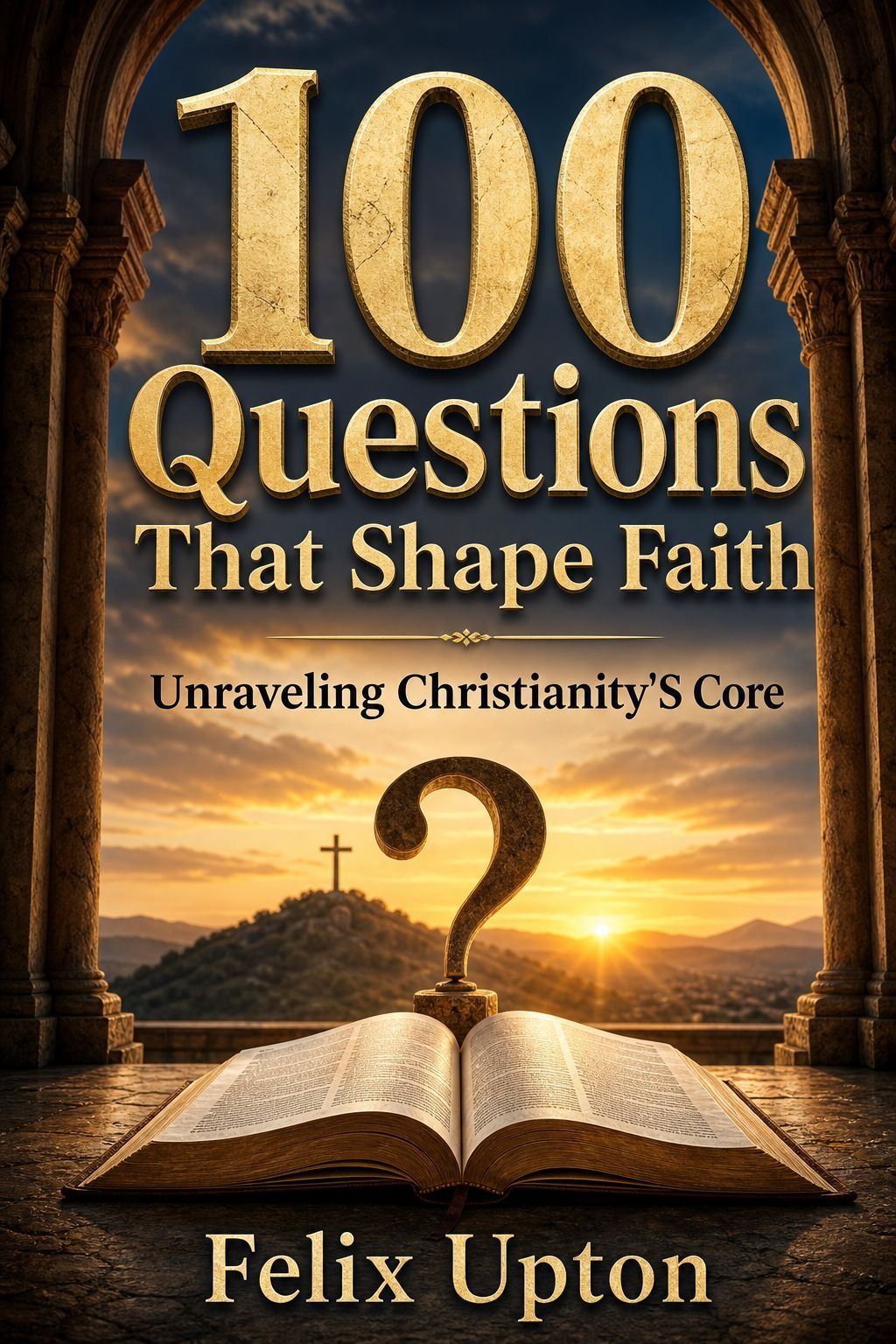
Buy this Book:
Religion / Christian Theology / General (REL067000)
100 Questions That Shape Faith
by Felix Upton
Listen to this review
100 Questions That Shape Faith is, by design, a catechetical book for readers who want Christianity explained in plain language without being flattened into slogans. Across ten chapters, it works through major doctrinal and practical questions in a sequence that is both accessible and cumulative: why questions matter in the life of faith, what Christianity is, who God and Jesus are, how the Bible can be trusted, why the world is broken, how salvation works, what Christian living looks like, how Christians should think about moral and social issues, and how faith relates to other religions, science, and the future. The result is a book that feels less like a set of isolated essays than a structured tour through the core claims of Christian belief.
One of the book’s chief strengths is its tone. It consistently treats inquiry as a faithful act rather than a threat. Chapter 1, “Why Questions Matter in the Life of Faith,” is especially effective in distinguishing sincere questions from mere curiosity, and in arguing that questioning can deepen rather than dissolve trust. That opening posture shapes the whole book. It allows the text to address difficult issues—sin, suffering, divine sovereignty, judgment, and moral discernment—without retreating into defensiveness. The prose is generally clear, measured, and pastorally alert. Even when the subject matter becomes theological, the language stays anchored in concrete human concerns: guilt, grief, worship, obedience, identity, and hope.
The book is strongest when it translates doctrinal claims into moral and existential stakes. Chapter 2’s explanation of the gospel, for example, succeeds because it makes a careful distinction between advice and news: Christianity is not primarily self-improvement, but announcement. That distinction gives the chapter conceptual force. Similarly, the treatment of grace in Chapter 7 resists the familiar religious instinct to earn divine favor. The book is clear that obedience matters, but as response rather than transaction. Its discussion of assurance is likewise useful, because it avoids both presumption and despair, tying confidence to Christ’s work while still taking repentance and fruit seriously.
The chapters on God, Jesus, and the resurrection also show the book at its best. Chapter 3 presents divine holiness, love, justice, and mercy as interlocking realities rather than competing traits, and it does so with commendable care. Chapter 4, “Who Is Jesus, and Why Does He Matter?” benefits from a similarly integrated approach: Jesus is not merely teacher, miracle worker, or Messiah in isolation, but all three together. The cross and resurrection are not treated as decorative doctrines but as the interpretive center of Christian faith, with the resurrection especially carrying the argument forward into hope, history, and embodiment. The emphasis on renewal rather than escape gives the book a more textured eschatology than some beginner texts manage.
Another notable strength is its attention to the Bible as a library of genres and historical witnesses rather than a simplistic proof-text sourcebook. Chapter 5 explains inspiration, canon, and wise reading in a way that should be accessible to readers who have heard the Bible cited often but never been taught how Christians understand its formation. The insistence that Scripture must be read in context, within the larger story of creation, fall, covenant, Christ, and restoration, is one of the book’s more mature instincts. It is also helpful that the book repeatedly frames reading as a form of submission as well as interpretation: Scripture does not merely answer questions; it reads the reader.
There is also real value in the book’s treatment of suffering and brokenness. Chapter 6 gives sin a relational and moral depth, not merely a legal one, and its discussion of lament, justice, and hope avoids sentimental closure. The book is at its most pastorally credible when it acknowledges that grief, injustice, and unanswered prayer do not vanish under theological language. Likewise, Chapter 8’s section on suffering, discipline, and grace recognizes that Christian growth is often slow, painful, and non-linear. That realism helps the book avoid the false cheerfulness that can weaken popular religious writing.
Still, the book’s strengths are also the source of some limitations. Its style is consistently explanatory and declarative, but rarely probing in a way that would satisfy readers looking for serious engagement with competing philosophical or historical arguments. The chapter titles promise breadth—especially in areas such as manuscript evidence, science, other religions, and the future—but the provided text tends to summarize Christian claims rather than stage real debate. For a newcomer, that can be reassuring. For a skeptical or academically trained reader, it may feel more like a confident overview than a genuinely dialogical account.
Relatedly, the book’s confidence sometimes comes at the cost of nuance. It is strongest when clarifying core Christian convictions, but weaker when the subject requires tighter differentiation among interpretations or traditions. Chapter 9, on moral and social issues, gestures toward sex, marriage, family, identity, technology, and culture, yet the excerpt provided develops those questions mostly at the level of principles rather than sustained case-making. Readers seeking detailed ethical argumentation will likely find this section too generalized. The same is true of Chapter 10’s treatment of science and other religions: the framework is balanced and hospitable, but the actual engagement remains introductory.
Structurally, the book is well organized, and the table of contents suggests a thoughtful progression from questions to doctrine to practice. The appendix—with reflection questions, a glossary, and suggested further study—reinforces the book’s use as a guide for individual readers, small groups, or church settings. If there is a weakness in the structure, it is that the book seems more designed to establish a framework than to linger over complexity. The cumulative effect is orderly and accessible, but not especially surprising. Readers already familiar with evangelical introductions to Christianity may recognize much of the conceptual terrain.
In the end, 100 Questions That Shape Faith is most valuable as a clear, pastorally minded introduction to Christianity for enquirers, new believers, and church groups wanting a readable doctrinal overview. It is less well suited to readers seeking rigorous academic argument, extensive historical documentation, or sustained engagement with objections from outside the Christian tradition. For its intended audience, though, it offers a coherent, serious, and often thoughtful map of the Christian faith.
Share-ready review images
Download square and vertical images for posts, stories, newsletters, and media kits.
For authors
Want a review page like this for your book?
Upload your manuscript, choose a review tier, and get a permanent public editorial review page you can share with readers.
Review My Book← Back to Reviews
